
A Sectional Warping Machine Maintenance Checklist That Cuts Downtime
Contents
Find the Right Sectional Warping Machine for Your Mill
Tell us your yarn types, loom widths and monthly volumes. Our team will show you what Ergomatic can do for your fabric and help you decide what you need.
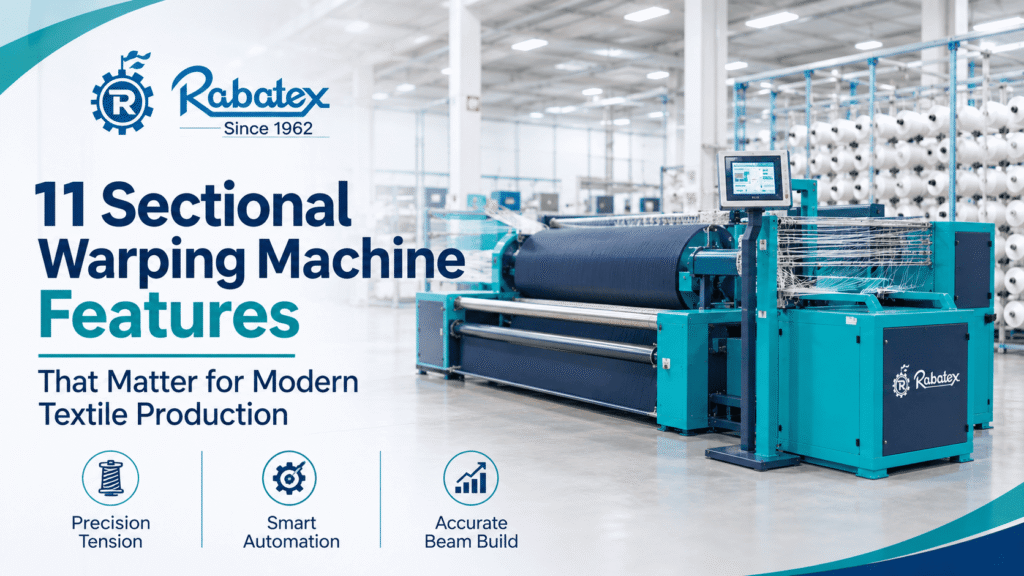
If you run a weaving unit, you already know where most fabric problems start. They start before the loom. A beam with uneven tension, a section that sits a few millimetres off, or a length that is short of what the order needs will show up later as warp breaks, stoppages and rejected metres. Fixing it at the loom is slow and expensive. Getting it right at warp preparation is far cheaper.
That is why the choice of a sectional warping machine deserves more attention than it usually gets. Two machines can look similar on a spec sheet and behave very differently on your shop floor. Speed control, yarn tension, section formation and automation are the four areas where the difference shows up, and they decide how consistent your beams are from the first one to the five hundredth.
In this guide, we will walk you through the features that matter, explain why each one affects your output, and show you how to rank them for your own mill. Whether you are buying your first machine or replacing one that has served you for fifteen years, you will come away with a clear checklist you can take into any supplier meeting.
11 Key Features to Look for in a Sectional Warping Machine
The right mix of mechanical design, automation and measurement can change how consistent your warp is, how smoothly your shift runs and how much yarn you waste. No single feature does it alone. A fast machine with weak tension control will only give you bad beams faster. So read each feature below with your own production in mind, and note which ones you cannot compromise on.
1.Reinforced Drum Construction
Everything in sectional warping happens on the drum. Every section you wind sits on it, and layer after layer of yarn presses on its surface. If the drum is not built to take that load, the problems start long before you notice them.
A drum that flexes even slightly under load, or slowly loses its true round shape, changes the yarn path. Tension varies from one section to the next, the build-up becomes uneven, and at high speed the drum can start to vibrate. None of this shows on day one. It shows up a year or two later as beams that get harder to build right.
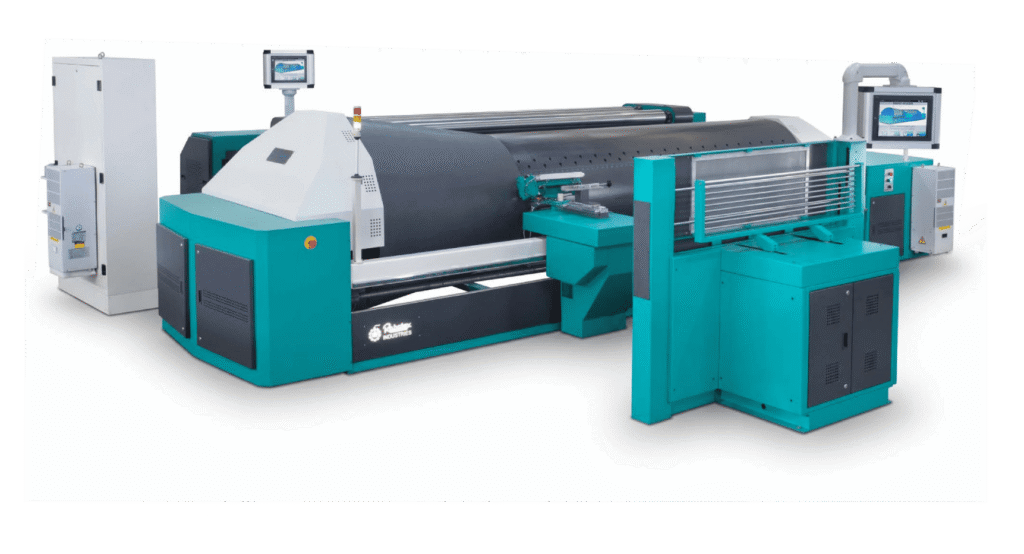
So look at how the drum is built. Internal support rings, fitted at regular intervals along the length of the drum, help it hold its shape under heavy, dense warp loading. Ergomatic, for example, has a drum reinforced with internal support rings at every 300 mm. That gives it the structural strength to stay true and perform reliably for years, even when you load it with high-density warps.
Here is what that means on your floor. Say you run a dense warp of fine count yarn with many ends per section. The load on the drum is high, and every section adds to it. A rigid drum keeps the winding surface consistent across the full width, so the first section and the tenth are built under the same conditions.
What goes wrong without it. A lightly built drum can develop slight deflection or lose its roundness with long use. You then see uneven section build, tension differences across the beam and more vibration as speed goes up. By the time you trace it back to the drum, you have already lost a lot of beams to it.
2.Controlled Warping and Beaming Speed
Speed sounds simple. Higher is better, right? Not exactly. What you want is speed you can control, and hold steady, across the whole run.
Two things matter here. The first is the maximum speed the machine can reach for warping and for beaming. The second is whether it holds a constant line speed while the beam diameter keeps growing. On a poorly controlled machine, the yarn speed changes as the beam fills up, and that shows up as tension variation.
A direct drive system helps with this. With fewer mechanical links between the motor and the beam, you get smoother acceleration, quicker response and less wear to maintain.
Take the Ergomatic sectional warping machine from Rabatex as an example. It is a hi-tech precision machine, and the speed figures show it. It warps at up to 1,000 metres per minute and beams at up to 200 metres per minute. If you are preparing a 50,000 metre warp for a long-run poplin order, the high warping speed gets the sections onto the drum quickly, while the slower beaming speed protects the beam build. You get throughput where it is safe and control where it counts.
When you compare machines, ask for the speed at which the machine gives you good beams, not only the top speed on the brochure.
What goes wrong without it. The common problem is a machine that runs fast but stops slowly. When an end breaks at high speed, the drum keeps turning until the brake brings it down. The longer that takes, the more yarn gets wound over the break, and your operator spends more time finding and repairing it. Poor acceleration is another one. A machine that jumps to full speed stretches the first layers and leaves a tension mark at the start of every section.
Speed also depends on the yarn. As a rule, you run finer and weaker yarns more slowly, and stronger, smoother ones faster.
| Yarn type | How to approach speed |
|---|---|
| Fine count combed cotton | Moderate speed, since low strength leaves little room for tension spikes |
| Polyester filament | Higher speed is usually possible, but watch static and package unwinding |
| Blended spun yarn | Somewhere in between, set by the weaker component |
| Coarse cotton or denim yarn | Higher speed on the drum, with tension kept steady |
3.Precise Yarn Tension Control
Yarn tension is the feature that most directly affects what your weaver sees on the loom. If tension is uneven across the beam, some ends run tight and some run loose. The tight ones break. The loose ones cause cockling and shade bars in the fabric.
Variation tends to appear in two places. It can happen while the yarn is being drawn through the creel and onto the drum, and it can happen when the warp is transferred from the drum to the beam. A good machine controls both.
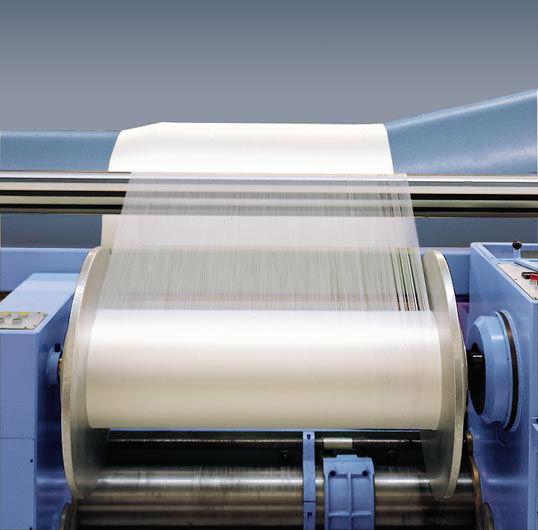
Take a mill running fine count cotton at 60s. This yarn has very little strength margin, so a small tension spike is enough to cause a break. In a mill like yours, a stable tension profile from the first metre to the last matters far more than a few extra metres per minute.
When you evaluate a machine, ask how it controls tension while beaming, not only on the drum. Servo valve based or similar closed loop systems adjust continuously as the beam builds up, so the last layer goes on with the same tension as the first. That consistency means fewer warp breaks at the loom and a smoother weaving efficiency curve across the full beam.
Where tension variation comes from. It rarely comes from one place. The creel design and tensioning arrangement, the way yarn unwinds from the package, the change in diameter as the build grows, and even a hot, dry shop floor all play a part. A machine can only correct what it controls, so you want to know where its control starts and ends.
What goes wrong without it. Take a mill weaving 100 percent cotton shirting. If the outer layers of the beam sit looser than the inner ones, the weaver sees warp breaks rise as the beam runs down. Weaving efficiency drops through the beam, and the weaving department blames the loom, when the cause was made at warping.
4.Accurate Section Formation and Traverse Control
In sectional warping, the warp is built section by section on the drum, following a defined sectional warping process. Each section has to sit exactly next to the one before it. If the section width is not uniform, or if the reed table and feeder table do not move accurately, you get gaps or overlaps at the edges. These show up later as uneven beam build and tension differences across the width.
Think of it like laying bricks. If every brick is off by a small amount, the wall still goes up, but by the time you reach the top, it leans.
What you want to look for is accurate traverse control of the reed table and the feeder table. Machines that use three-axis servo control can position these elements precisely and repeat that position every section. The mechanical arrangement also counts. A ball screw and linear guide system gives smooth, low-backlash movement that stays accurate over years of use.
Ask the supplier what drives the reed table and feeder table, and how the movement is guided. Three-axis servo control with a ball screw and linear guide arrangement is the combination to look for. It keeps section edges clean and the beam evenly built across the whole width, even on long runs with many sections.
What goes wrong without it. Section edges are where small errors add up. If one section sits half a millimetre too close, the yarn overlaps and builds a hard ridge. If it sits too far, you get a gap and a soft stripe. Either one shows up when the warp is transferred to the beam, and it can end up as a visible streak in the fabric. The more sections you build, the more often the machine has to get it right.
Taper and reed pitch matter too. Each section is wound with an angled edge so the next one can lock against it. The right angle is different for slippery filament yarn and for hairy spun yarn. The reed pitch sets how closely the ends sit together within a section, so it should suit your yarn counts.
5.Laser-Based Measurement and Monitoring
If you have ever had a beam come out a few hundred metres short, you know why measurement matters. You find out at the loom, usually at a bad time, and the fix is to splice in extra yarn or scrap the beam.
Laser-based measurement helps in three ways. It measures yarn build-up as the beam fills. It measures the density of the build. And it gives you an online reading of the actual length on the beam, not just an estimate based on drum revolutions.
That last point is the one buyers should care about. Actual length measurement means you know what you have produced while you are still producing it.
Ergomatic uses laser sensors for these measurements and sets the feed value automatically based on what they read. So instead of your operator adjusting the feed by feel, the machine does it from data. For a mill that runs many different warp lengths, this takes a lot of guesswork out of daily work.
What goes wrong without it. Estimating length from drum revolutions is not reliable, because yarn can slip and the build-up changes. A one per cent error on a 20,000 metre warp is 200 metres. Your weaver either runs short and has to tie in a new beam, or finishes with metres of wasted yarn left on the beam. Across hundreds of beams a year, that waste adds up.
Density is the other half. Measuring how tightly the yarn builds up tells you whether the beam is evenly hard. A soft beam can slip, and a very hard one can crush the yarn.
6.PLC-Based Automation and Programmable Operations
Automation matters most in the small repeated tasks that eat up your operator’s time and introduce variation between shifts. Think of positioning the start of each section, making the lease, and cross-winding the beam.
A PLC-based system can handle these. Automatic section start positioning means the machine goes to the right place by itself. Programmable leasing lets you set the lease pattern for the yarn and the job rather than doing it by hand. Programmable beam cross winding sets up the beam properly for the next stage.
Here is an example. Say your night shift has a newer operator and your day shift has a senior one. On a manual machine, the leasing quality might differ between them. With a programmable system, both shifts run the same program and you get the same result.
Ask which of these operations the control system handles on its own and which still need your operator. Section start positioning, programmable leasing and programmable beam cross winding should all be set once for a quality and repeated automatically. That reduces your dependence on individual operator skill and the variation from beam to beam.
What goes wrong without it. On a manual machine, quality depends on who is standing at it. A senior operator leases carefully and starts every section on mark. A newer operator on night shift may not. You then see more variation from shift to shift and more time lost on setup.
A real example. Say you switch between five fabric qualities in a week. If the machine stores a program for each one, your operator selects the quality, and the machine sets the section start, leasing and cross winding to match. Changeover time drops, and so do mistakes.
7.Operator Interface and Fault Diagnosis
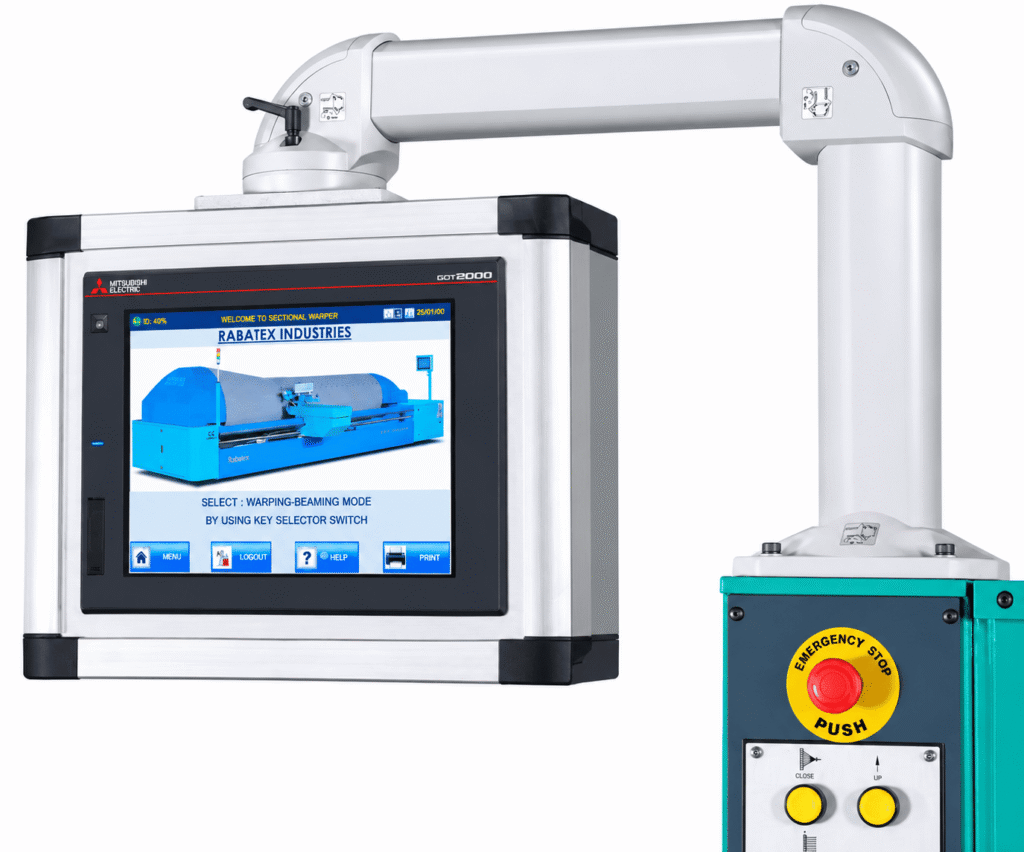
A good operator interface makes the machine easier to run and much easier to fix when something goes wrong. Look for a touchscreen HMI that shows machine and drive parameters in one place, and that keeps a record of faults and events.
Why does the event history matter? Imagine your machine stops twice in a week at around the same stage of a run. Without a history, you are guessing. With one, your maintenance team can see what happened, when it happened and which parameter was involved. That cuts the time from fault to fix.
Ask to see the screen during a demo. Check whether there is an HMI at both the warping and beaming stations, so your operator does not have to walk to a single panel. Parameters, drive status, and faults should be on screen where the work is happening.
What goes wrong without it. When a machine stops, the first question is why. Without clear fault messages, your electrician can spend an hour tracing the cause. With a fault history, the screen can tell you that a drive overheated or a sensor lost signal, and when. Over a year, that saves a lot of hours.
Beyond fault messages. A good HMI also shows how the machine is running, such as speed, tension and length for the beam in progress. Some let you set user levels, so only supervisors can change critical settings. Others show production data like beams made and length per shift, which helps with your planning.
8.Beaming Unit and Beam Handling Arrangement
Beam handling is the part of the process people tend to forget when they compare machines, and then remember on the first day of production. Every beam that goes on and comes off has to be positioned, locked, and moved safely. If the arrangement is awkward, it costs you minutes on every beam, and it puts your operators at risk.
Look for secure beam positioning and locking, a proper donning and doffing arrangement, and a direct beaming drive. A direct drive here gives you the same benefit as it does on the warping side, which is smoother and more accurate control.
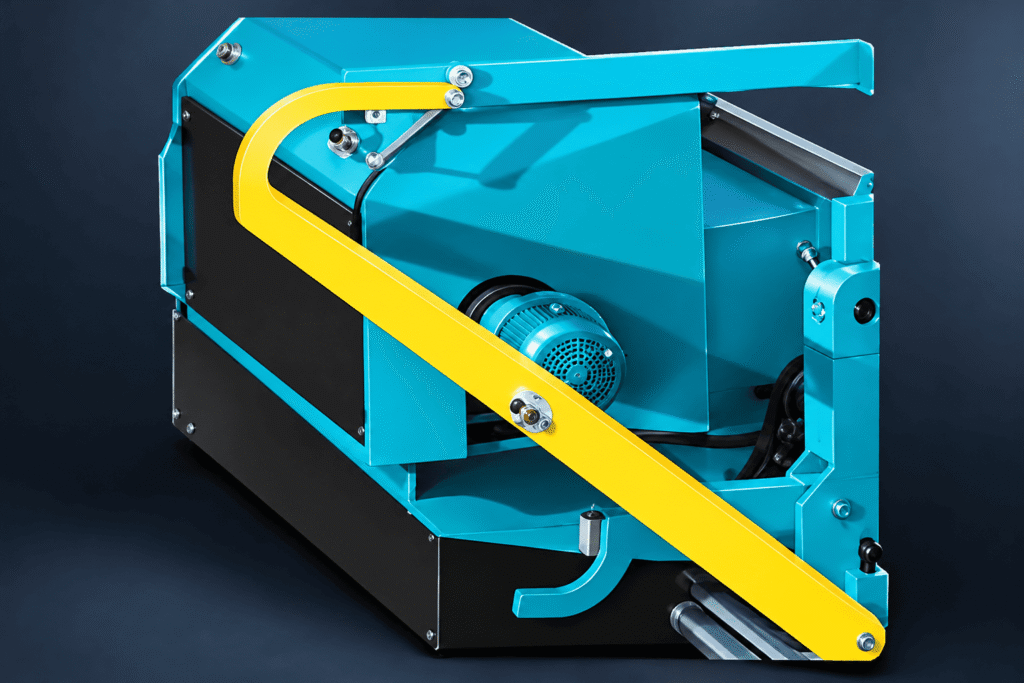
Ergomatic uses a separate beaming unit with a hydraulic donning and doffing device. Because the beaming unit is separate, the beaming process is independent of the drum, and hydraulic handling means your operators are not lifting or wrestling with heavy beams. If you change beams ten or fifteen times a day, you will feel the difference within the first week.
What goes wrong without it. Think of a mill that changes ten beams a day. If each change takes five minutes longer than it should, that is almost an hour lost every day. Poor beam alignment is the other problem. A beam that sits slightly off winds unevenly, and you only see the fault at the loom.
9.Machine Safety and Data Backup
Safety features rarely come up in a spec comparison, but they are the ones you will be glad you checked. A warping machine runs at high speed with a lot of stored energy in the drum and beam.
Look for safety photocells that stop the machine when someone enters a danger zone. Look for a disc brake with an accumulator, so the machine can stop reliably even if there is a loss of power. And look for UPS backup for critical production data, so a power dip does not wipe out the program, the length data or the job in progress.
Think about what happens in a mill that has frequent voltage fluctuations. Without backup, a power cut in the middle of a 30,000 metre warp could mean you lose track of where you are and have to start over. With a UPS, you save the job and carry on.
Whichever machine you choose, ask for a list of safety devices and confirm how it handles a power cut mid-run. These checks take ten minutes and can save you a lot of trouble later.
What goes wrong without it. A high-speed drum carries a lot of energy. If a hand or sleeve reaches the danger zone, you want the machine to stop at once, not after a few more rotations. And if data is lost in a power dip, nobody knows how many metres are on the beam, which means measuring it again by hand.
10.Creel Design and Yarn Feeding
The warping machine can only be as good as the yarn feeding it. The creel decides how evenly yarn comes off the packages. Depending on your production setup, you can consider different warping creel configurations to suit your yarn feeding and package handling requirements. Look at how the creel holds the cones, how it handles different package sizes, and whether a stop motion halts the machine at once when an end breaks.
If you run many qualities, ask about creel setups that allow quick changeovers. For a mill that switches between cotton and polyester several times a week, a flexible creel saves hours every month.
11.Quality of Components and After-Sales Support
Two machines can show the same speed on paper and age very differently. The difference is in the technology parts. Drives, servo motors, PLCs and sensors from established Japanese and European brands tend to perform consistently and last longer, which keeps your maintenance costs and downtime low. At Rabatex, we use Japanese and European brands for technology parts and source them through our global suppliers, because these parts give you the performance, efficiency and part life your production depends on.
Then ask about installation, commissioning, troubleshooting and after-sales service support. How quickly can the supplier reach you when something stops? Are spares available locally? Will someone train your operators? We provide service support for every machine we sell, because we are a customer-centric company and a machine that sits idle helps nobody.
How to Prioritise These Features for Your Textile Production Requirements
You will not need every feature at the same level, and you do not need to pay for capability you will never use. The easiest way to decide is to split your list into two groups. The first group is what you need for the work you are doing today. The second is what will support the work you expect to do in the next three to five years.
Start with the basics of your production. Look at the yarn types you run, the fabric specifications you weave, your monthly volumes and the equipment you already have. A mill that weaves fine count cotton for shirting has different priorities from one that weaves heavy denim or a polyester blend. And a mill planning to add looms next year should think about capacity now, not after the machine is installed.
Here is a compact table you can use as a starting point.
| Feature | Why it matters | Higher priority if you... |
|---|---|---|
| Working width and beam capacity | Sets the widest and heaviest beam you can build | Run wide looms or long warp lengths |
| Warping and beaming speed | Decides throughput and beam quality | Handle large volumes or long runs |
| Yarn tension control | Directly affects warp breaks at the loom | Weave fine counts or delicate yarns |
| Section and traverse accuracy | Keeps beam build even across width | Run many sections per beam |
| Laser measurement | Gives actual length and density data | Run varied warp lengths and tight orders |
| PLC automation | Repeats quality between shifts | Depend on multiple operators or shifts |
| HMI and fault diagnosis | Cuts time from fault to fix | Have limited maintenance support |
| Beam handling | Saves time and effort on every beam | Change beams many times a day |
| Safety and data backup | Protects people and production data | Have unstable power or high headcount on the floor |
| Creel design and yarn feeding | Decides how evenly yarn reaches the drum | Run many yarn qualities or frequent changeovers |
| Component quality and service support | Affects part life, downtime and running cost | Run long hours or are far from a service centre |
Once you have your own priorities, talk to your supplier about them directly. This is where Rabatex does things a little differently. Our approach is to educate you on how the machine works and what output it will give for your specific yarn and fabric, before you decide. We do this because we are solution providers, not only machine sellers, and a machine that suits your mill will serve you better than the one that looked best in a catalogue.
And if you are expanding or setting up new premises, this is the best time to involve us. Layout, machine count, loom matching and future capacity are all easier to plan before the building is finished than after.
Questions to Ask a Supplier Before You Buy
Take this list into your next meeting.
- Can the machine hold constant tension from the first layer to the last on my yarn count?
- What length accuracy can I expect, and how is it measured?
- How long does a beam changeover take with my operators?
- Which technology parts are used, and from which brands?
- What happens to my job data in a power cut?
- Where is your nearest service team, and how quickly can they reach me?
- Can you show me a running machine on my yarn type?
The Right Machine Features Make a Difference in Textile Production
A good sectional warping machine gives you stable tension, accurate sections, measured lengths, repeatable automation and safe, easy beam handling. Match those features to your own yarns, looms and volumes, and skip what you will not use.
Rabatex has built textile machinery since 1962, and corporates across India run more than 3,600 of our sectional warpers. We are export-ready too. Review the Ergomatic specifications and talk to our team about your production requirements. We will show you what the machine can do for your fabric.
FAQs
How does a sectional warping machine maintain uniform yarn tension?
It does this by controlling tension at the creel, on the drum and during beaming. On Ergomatic, a servo valve-based system keeps the beaming thread tension constant as the beam diameter grows. That means the last layer of yarn goes on with the same tension as the first, which gives you a beam that behaves the same way from start to finish at the loom.
What is the ideal warping speed for textile production?
There is no single ideal speed. It depends on your yarn count, yarn strength and the quality of the creel. A fine count cotton needs a more careful speed than a coarse polyester. What matters is that the machine holds a constant speed and tension at the speed you choose. Ergomatic warps at up to 1,000 metres per minute, and you can run it lower when your yarn needs it.
How does servo control improve the accuracy of a sectional warping machine?
Servo control lets the reed table and feeder table move to exact positions and repeat them for every section. With three-axis servo control, as on Ergomatic, your section edges line up properly. This avoids gaps and overlaps, which are a common cause of uneven beam build and tension variation across the width.
What is the role of laser measurement in sectional warping machines?
Laser sensors measure yarn build-up, density and the actual length on the beam while you are warping. This means you know what you have made as it happens. On Ergomatic, the laser sensors also help set the feed value automatically, so your operator does not need to adjust it by feel.
How does automation improve sectional warping operations?
Automation takes the repeated manual tasks, such as positioning the start of a section, leasing and cross winding, and makes them consistent. With a PLC-based system, every shift runs the same program, so beam quality does not depend on which operator is on duty. It also saves time on every beam.
What causes uneven section formation during sectional warping?
The usual causes are inaccurate reed table or feeder table movement, uneven tension between sections, wear in the traverse mechanism and incorrect section width settings. Servo-driven traverse with a ball screw and linear guide arrangement reduces most of these, because the movement stays accurate and repeatable over time.
How do warping speed and beaming speed affect production?
Warping speed decides how quickly yarn goes onto the drum, and beaming speed decides how carefully it is transferred to the beam. Running warping fast and beaming at a controlled speed gives you throughput without hurting beam quality. Ergomatic is designed around this, with warping up to 1,000 metres per minute and beaming up to 200 metres per minute.
Which technical specifications should be compared when purchasing a sectional warping machine?
Compare working width, beam flange diameter, warping and beaming speed, tension control method, traverse and servo arrangement, measurement method, level of automation, HMI and diagnostics, beam handling and safety features. Also ask about the brands used for technology parts and the service support available after installation.
How does a sectional warping machine handle different yarn types?
It depends on how well you can set and hold tension and speed for each yarn. Cotton, polyester, viscose and blends all behave differently. A machine with precise tension control, programmable settings and good measurement lets you save parameters for each quality and reuse them, so changing from one yarn to another is quicker and more consistent.
What maintenance factors should be considered when selecting a sectional warping machine?
Look at the quality and life of the technology parts, how easy it is to access wear parts, the diagnostics available on the HMI and the service support from the supplier. Machines built with Japanese and European technology parts tend to have good part life, and fault history on the HMI helps your team find issues early.
Related Posts
What Is a Vertical Lift Module? A Complete Guide to VLM Storage Systems
Walk into almost any textile manufacturing facility, and you’ll notice
How to Choose the Right Sectional Warping Machine for Your Textile Mill
“The loom has stopped again.” No production manager wants to

How Apparel Manufacturers Speed Up Fabric Development with Sample Warping Machines
“Can we see two more fabric options before we finalize