
“The loom has stopped again.”
No production manager wants to hear those words, especially when there’s a delivery deadline to meet.
The first reaction is usually to check the loom. The settings look fine. The yarn looks fine, too. Then someone says, “Let’s check the warp beam.” More often than not, that’s where the real issue is hiding.
If you’ve dealt with uneven beam build, frequent yarn breaks, or inconsistent warp tension, you already know how quickly these problems affect the rest of the weaving process. And once production starts, fixing them isn’t easy.
That’s why choosing a sectional warping machine deserves more than a quick comparison of speeds and specifications. Before you invest, you need to know whether the machine can handle your yarns, support your production targets, and continue delivering consistent performance as your business groNot every sectional warping machi ws.
In this guide, we’ll walk through the factors that matter when selecting a sectional warping machine. We’ll also compare the Rabatex range and help you understand which model is better suited for different textile manufacturing requirements.
What Is a Sectional Warping Machine and Why Does It Matters?
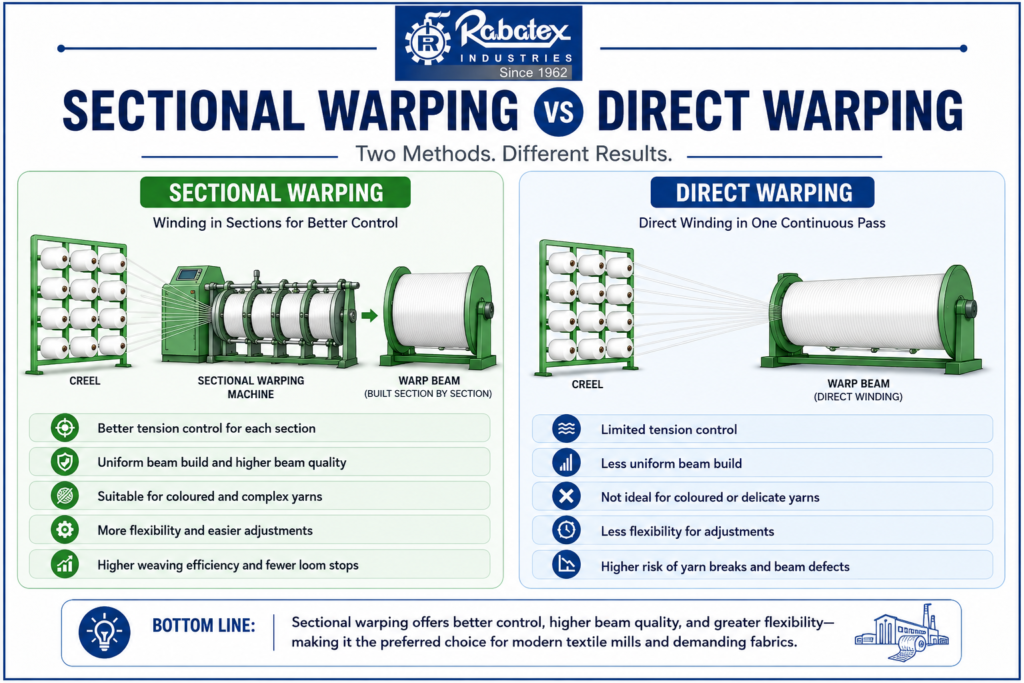
A sectional warping machine builds your warp beam section by section, winding yarn from a creel onto a drum in narrow bands before transferring it to the beam. This is different from direct warping, where yarn goes straight onto the beam in one pass.
Sectional warping gives you far more control over tension and yarn placement, which is exactly why it is the standard choice for mills that need consistent, high-quality beams.
A denim mill that runs into tension problems will usually see it as shade variation across the warp once the fabric is indigo dyed. A terry towel manufacturer will see it in uneven pile height. In both cases, the fault traces back to warp preparation, not the loom. The right textile warping machine gives you:
- Consistent tension across every section of the beam
- Beam quality that holds up through the entire weaving run
- Higher loom efficiency because your weavers are not constantly troubleshooting
- Stable production instead of unpredictable output
- Fabric quality that meets your buyer’s specifications without exceptions
6 Common Mistakes Textile Mills Make When Buying a Sectional Warping Machine
Before we get into what to look for, let’s talk about where mills usually go wrong with this decision. Chances are, you have seen at least one of these play out on your own shop floor.
Mistake #1: Choosing a Sectional Warping Machine Based Only on Price
A lower-priced machine may reduce your initial investment, but the purchase price is only one part of the overall cost. Frequent maintenance, higher yarn waste, lower productivity, and unexpected downtime can make a cheaper machine more expensive to operate over time.
Instead of comparing only prices, evaluate:
- Production efficiency
- Automation capabilities
- Energy consumption
- Expected machine life
- Service and spare parts support
Mistake #2: Selecting the Wrong Working Width
Many textile mills choose a working width based only on their current production requirements. As product portfolios expand or new fabric categories are introduced, the machine may no longer support the mill’s growing needs.
Before finalizing the machine, consider:
- Current fabric widths
- Future product expansion
- Beam flange requirements
- Production flexibility
Mistake #3: Ignoring Future Production Expansion
A sectional warping machine is a long-term investment, so your decision should support where your business is headed, not just where it is today. Planning for future growth can help you avoid costly machine upgrades or replacements in the coming years.
Ask yourself:
- Will production volumes increase?
- Are you planning to add new fabric categories?
- Will you require higher automation later?
- Can the machine support future capacity requirements?
Mistake #4: Investing in Features That Don’t Match Your Production Requirements
Every textile mill has different production goals. Investing in advanced automation without understanding your operational needs can increase costs without delivering proportional benefits.
Evaluate whether you actually need:
- Full servo automation
- Advanced monitoring features
- Higher production speeds
- Integrated or separate beaming
- Digital production management
Mistake #5: Overlooking the Manufacturer’s Service and Support
Even a well-built sectional warping machine will require maintenance, spare parts, and technical support during its lifecycle. Delayed service or limited spare parts availability can disrupt production and increase operating costs.
Before choosing a manufacturer, check:
- Installation support
- Operator training
- Spare parts availability
- Service response time
- Technical assistance
Mistake #6: Comparing Specifications Instead of Production Performance
Machine specifications help you compare features, but they don’t always reflect day-to-day performance on the shop floor. A machine that delivers consistent beam quality, stable yarn tension, and reliable operation will often provide greater long-term value than one with higher specifications alone.
Look beyond the brochure and evaluate:
- Yarn tension consistency
- Ease of operation
- Beam quality
- Machine reliability
- Performance with your yarn types
8 Key Factors to Consider Before Buying a Sectional Warping Machine
1. Choose the Right Working Width and Beam Size
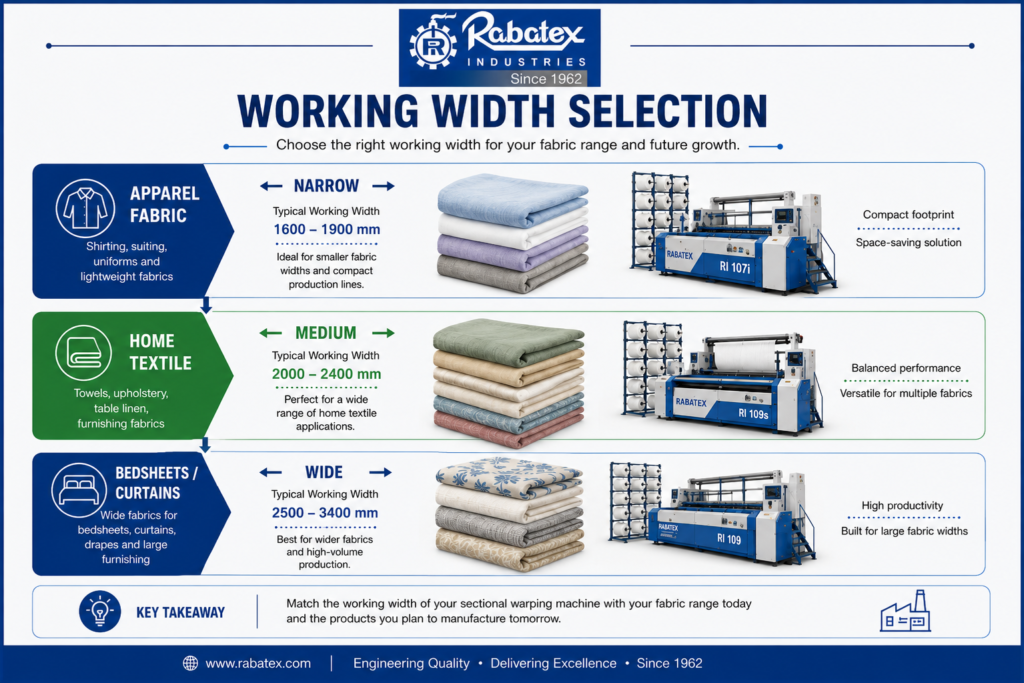
Start by looking at the types of fabrics your mill produces. The working width of the machine should comfortably accommodate your current product range while leaving room for future expansion.
For example, a home textile manufacturer producing bedsheets or curtains may require a wider working width than an apparel fabric mill producing shirting or suiting fabrics.
When evaluating a machine, check:
- Working width options available
- Beam flange diameter compatibility
- Fabric widths you currently manufacture
- Potential future product expansion
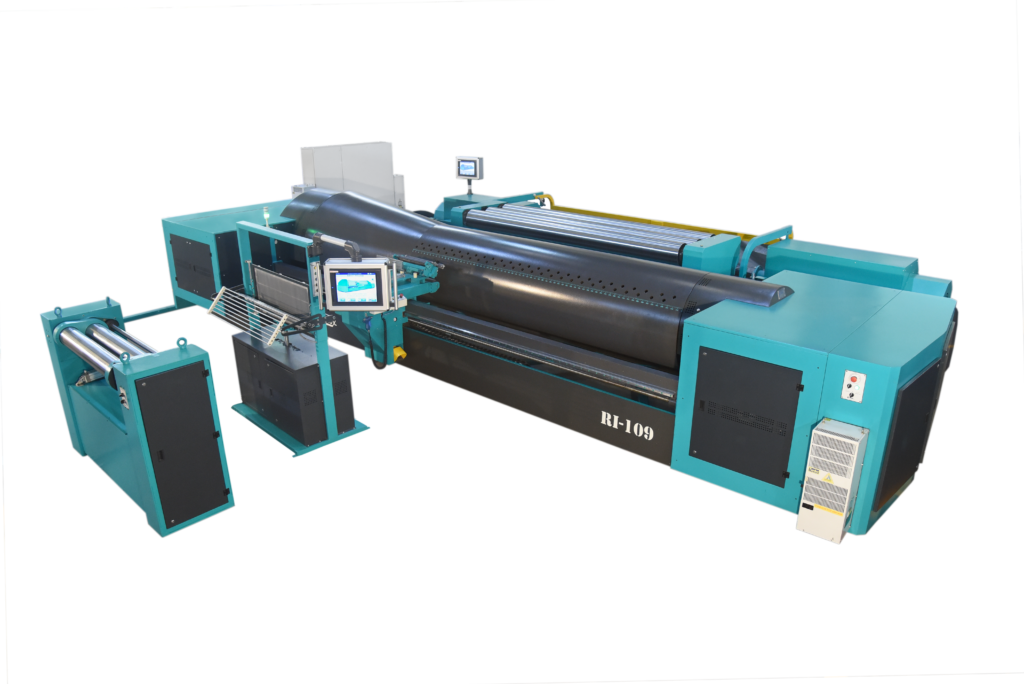
For mills producing a wide variety of fabrics, machines like the Rabatex RI 109, with working widths ranging from 1,900 mm to 4,400 mm and beam flange diameters up to 1,250 mm, provide greater production flexibility.
2. Evaluate Warping and Beaming Speed Based on Your Production Capacity
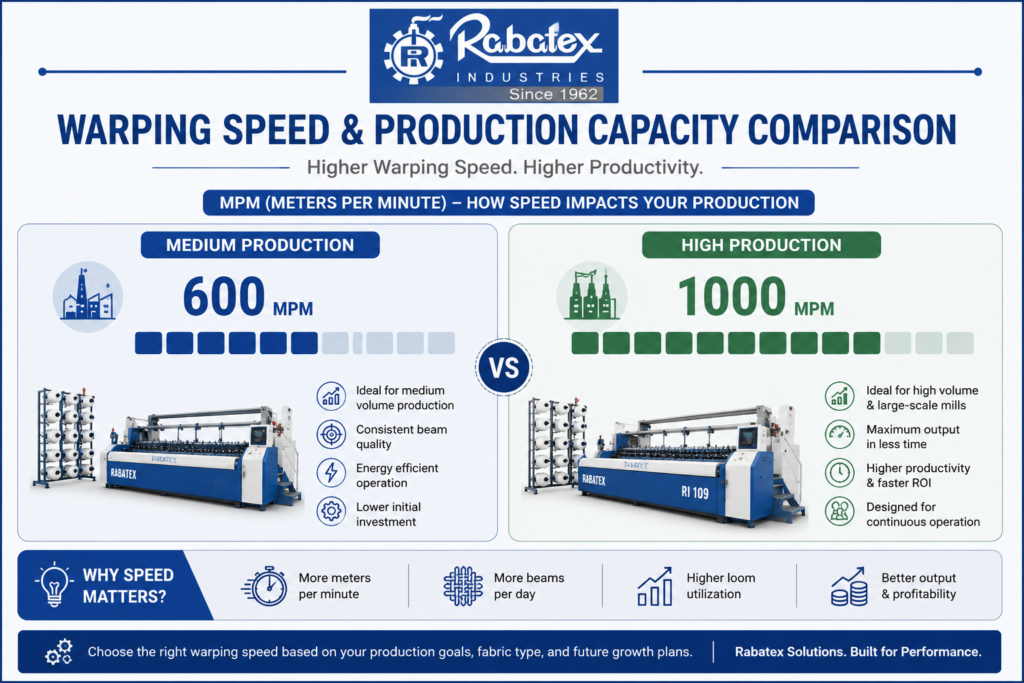
A higher machine speed can improve productivity, but only when it matches your production requirements. Investing in maximum speed makes little sense if your weaving capacity or order volumes don’t demand it.
For example, a denim mill running multiple weaving machines around the clock will benefit from a high-speed sectional warping machine. A smaller textile unit with moderate production may achieve better value from a machine designed for medium production volumes.
Consider the following while comparing machines:
- Maximum warping speed
- Beaming speed
- Daily production targets
- Number of looms supported
- Overall production workflow
The Rabatex RI 109 offers warping speeds of up to 1,000 MPM and beaming speeds of 200 MPM, making it suitable for high-output weaving operations.
3. Look for Accurate Tension Control and Yarn Placement
Consistent yarn tension is one of the biggest contributors to beam quality. Even minor variations during warping can lead to weaving interruptions, fabric defects, and increased yarn waste.
If your mill works with fine yarns, denim yarns, or technical textile applications, precision becomes even more important.
Look for features such as:
- Servo-controlled yarn guide movement
- Laser-based yarn build-up measurement
- Uniform yarn placement
- Stable beam formation
- Consistent tension across every section
These features help produce beams that unwind smoothly during weaving and reduce unnecessary loom stoppages.
4. Select the Right Level of Automation
Automation should solve production challenges, not simply add more technology.
Modern sectional warping machines offer features that improve consistency, simplify machine operation, and reduce manual intervention. The level of automation you choose should match your production volume and operational requirements.
Evaluate automation features such as:
- PLC control system
- Touchscreen HMI
- Multi-axis servo drives
- Production monitoring
- Broken end memory
- Event history and diagnostics
How Automation Supports Long-Term Productivity
The right automation package can help your mill:
- Reduce labour dependency
- Minimize yarn waste
- Reduce manual adjustments
- Detect issues faster
- Lower machine downtime
- Improve beam consistency
- Reduce long-term operating costs
If your production involves frequent style changes or demanding quality standards, investing in higher automation often delivers better returns over the machine’s lifetime.
5. Choose the Right Beaming Configuration
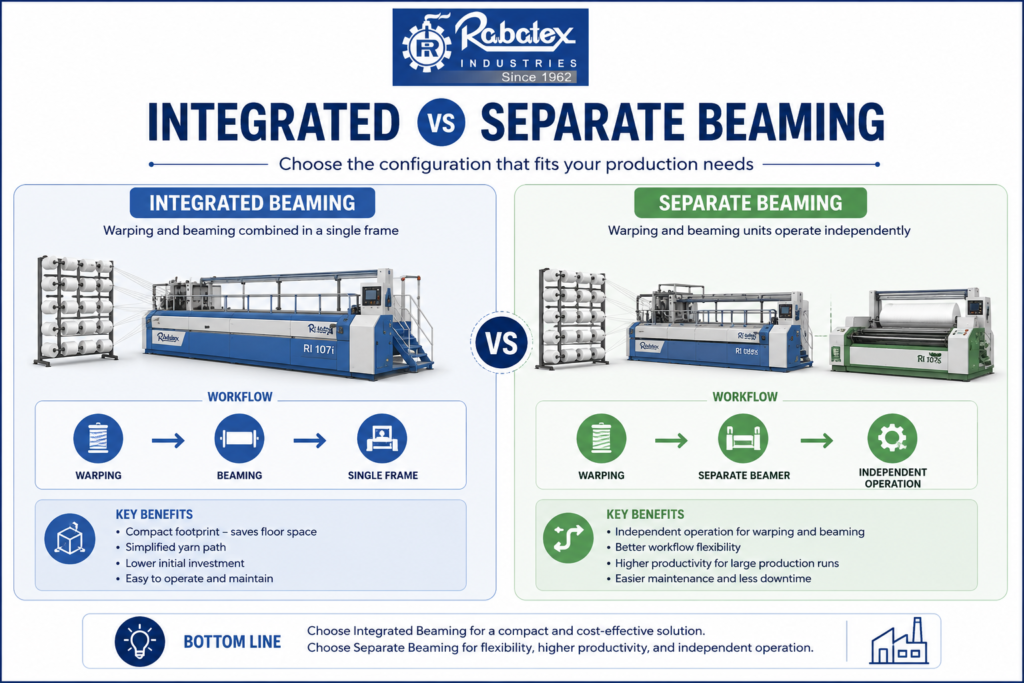
One of the key decisions is whether your mill needs an integrated beaming unit or a separate beaming unit. The answer depends on your available floor space, production planning, and workflow.
Integrated Beamer
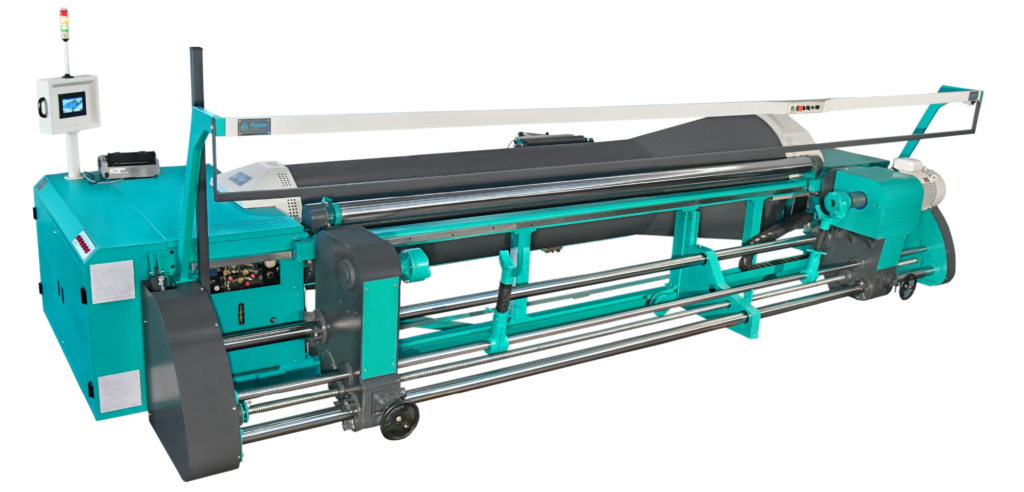
An integrated beaming configuration combines warping and beaming into a single setup.
It is generally preferred when:
- Floor space is limited
- A compact machine layout is required
- Simpler production flow is preferred
The Rabatex RI 107i is designed for manufacturers looking for an integrated solution without compromising performance.
Separate Beamer
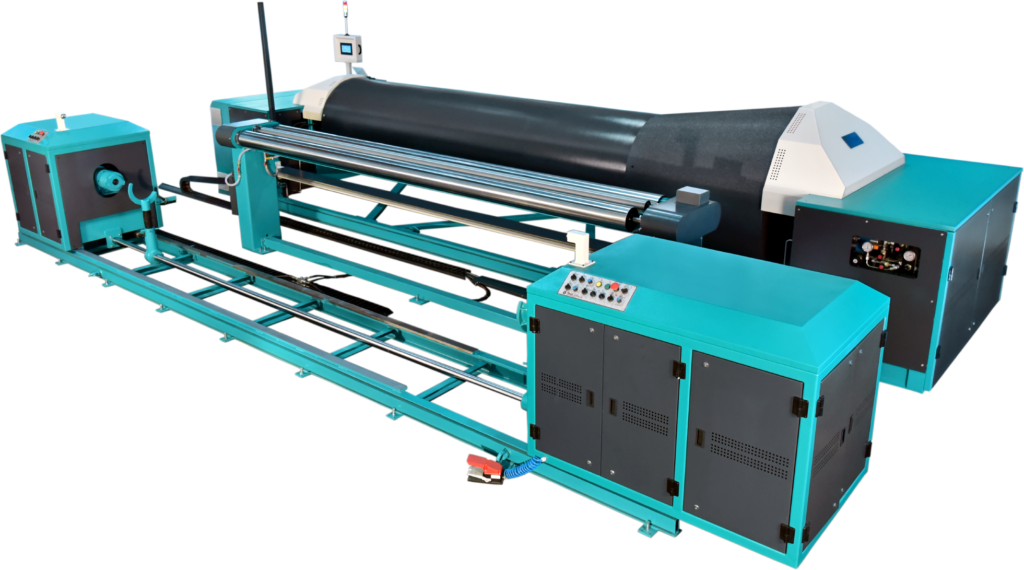
A separate beaming unit gives greater flexibility by allowing beaming operations to be carried out independently.
This configuration is well suited for mills that:
- Handle multiple production orders
- Need greater workflow flexibility
- Prefer independent beaming operations
The Rabatex RI 107s offers this flexibility, making it a practical choice for manufacturers with diverse production requirements.
6. Match the Machine to Your Yarn Types and Fabric Applications
Not every sectional warping machine is suited for every application. Your choice should reflect the yarns you process and the fabrics you manufacture every day.
For example:
- Denim manufacturers often require higher production speeds and precise tension control.
- Home textile manufacturers may need wider working widths for bedsheets and furnishing fabrics.
- Technical textile manufacturers generally require higher accuracy and process consistency.
- Terry towel manufacturers should focus on machines that maintain uniform beam build across different yarn counts.
Before making your decision, evaluate whether the machine is suitable for:
- Cotton yarns
- Blended yarns
- Filament yarns
- Technical yarns
- Fine and coarse yarn counts
Choosing a machine designed for your applications helps improve both productivity and fabric quality.
Some textile applications also require specialized sectional warping solutions. For example, manufacturers working with mono mother yarn splitting need a machine designed specifically for that process. Watching an actual production setup can help you better understand how these specialized applications differ from conventional sectional warping.
7. Plan for Future Production Growth
A sectional warping machine is expected to serve your mill for many years. While your current production requirements are important, they shouldn’t be the only factor influencing your decision.
Think about where your business could be five years from now.
Consider questions like:
- Will production capacity increase?
- Are you planning to manufacture wider fabrics?
- Will you diversify into new textile segments?
- Could your automation requirements change?
Choosing a machine with room for future expansion can help avoid another major investment as your production grows.
8. Evaluate the Warping Machine Manufacturer and After-Sales Support
The machine is only one part of your investment. The support you receive after installation plays an equally important role in keeping production running smoothly.
Before selecting a textile machinery manufacturer, evaluate their ability to support your operations over the long term.
Look for:
- Industry experience
- Installation and commissioning support
- Operator training
- Spare parts availability
- Technical service
- Upgrade options
- Customer references from similar textile segments
Working with an experienced manufacturer such as Rabatex also gives you access to a wider portfolio of warping solutions, making it easier to choose a machine that fits your production requirements today and supports your business as it grows.
Compare Rabatex Sectional Warping Machines
Every textile mill has different production goals. Some prioritize high production speeds, while others focus on floor space, flexibility, or cost-effective upgrades. That’s why Rabatex offers multiple sectional warping machine models, each designed to address specific manufacturing requirements.
The comparison below gives you a quick overview before we look at where each machine fits best.
| Machine | Best For | Key Features |
| RI 109 | High-volume textile mills | 3-axis servo control, laser sensor, up to 1000 MPM warping speed, 200 MPM beaming speed |
| RI 107i | Mills needing a compact solution | Integrated beaming unit, space-efficient design |
| RI 107s | Mills needing flexible production | Separate heavy-duty beaming unit, independent beaming operation |
| RI 1006+ | Small and medium textile manufacturers | Metallic drums, AC inverter drive, up to 600 MPM warping speed |
Which Rabatex Model Is Right for Your Textile Mill?
The best machine depends on your production requirements, available space, and future plans. Here are a few common scenarios to help you narrow down your options.
Choose RI 109 for High-Speed, High-Volume Production
If your mill runs multiple looms and handles large production volumes every day, productivity and consistency become top priorities.
The Rabatex RI 109 is well suited for manufacturers looking for:
- High-speed warping up to 1000 MPM
- Servo-controlled precision
- Laser-based yarn build-up measurement
- Consistent beam quality
- Reduced manual intervention
It is an ideal choice for:
- Denim manufacturers
- Large home textile manufacturers
- Technical textile manufacturers
- High-capacity weaving units
Choose RI 107i When Floor Space Is Limited
Not every mill has room for a large machine layout. If you’re planning a new setup or upgrading an existing production floor with limited space, an integrated beaming configuration can be a practical option.
The Rabatex RI 107i offers:
- Integrated beaming unit
- Compact machine layout
- Simplified material flow
- Efficient use of available floor space
It works well for:
- Apparel fabric manufacturers
- Home textile manufacturers
- Mills expanding within an existing facility
Choose RI 107s for Greater Production Flexibility
Some weaving units process multiple orders throughout the day. In such cases, independent beaming operations can help improve workflow and reduce production bottlenecks.
The Rabatex RI 107s is designed for mills that need:
- Separate heavy-duty beaming
- Flexible production planning
- Independent machine operation
- Better workflow management
It is commonly suited for:
- Terry towel manufacturers
- Industrial fabric manufacturers
- Textile mills handling varied production schedules
Choose RI 1006+ for Reliable Everyday Performance
If you’re replacing an older sectional warping machine or expanding production without investing in full servo automation, the Rabatex RI 1006+ offers a dependable solution.
Its features include:
- Metallic drums
- AC inverter drive
- Warping speed up to 600 MPM
- Direct beaming through a planetary gearbox
It is a practical choice for:
- Small and medium textile manufacturers
- Growing weaving units
- Mills looking for a balance between performance and investment
Choosing the Right Sectional Warping Machine for Your Textile Mill
When you put it all together, the decision comes down to a handful of factors: working width, production speed, tension control, automation level, beaming configuration, application suitability, future growth plans, and the manufacturer standing behind the machine.
The right sectional warping machine should not just meet your production needs today. It should support your mill’s growth for years to come, whether you are running a denim operation chasing consistency at scale, a home textile unit balancing variety, or a technical textile plant that cannot afford tolerance issues.
This is exactly where Rabatex stands apart. Rabatex Industries has been building warping and textile preparatory machinery since 1962, which means over 60 years of manufacturing experience behind every sectional warping machine that leaves the factory. That experience shows up in machine reliability, in a repeat order rate of more than 43 percent from mills that keep coming back, and in a service network that has supported installations across 38 countries.
Whether you need the high-speed precision of the RI 109, the compact efficiency of the RI 107i, the flexibility of the RI 107s, or the dependable performance of the RI 1006+, Rabatex has a machine built for your stage of growth.
Ready to Find the Right Sectional Warping Machine for Your Mill?
Talk to the Rabatex team about your working width, production volume, and automation needs, and get a recommendation built around your mill instead of a generic spec sheet.
FAQs
- How do I choose the right sectional warping machine for my textile mill?
Start with your working width and beam size needs, then factor in your required production speed, tension control precision, and automation level. Match these against your fabric type and future growth plans before finalizing a model. - What is the difference between an integrated and separate beaming unit?
An integrated beamer combines warping and beaming in one compact frame, ideal for mills with limited floor space. A separate beamer operates independently, allowing parallel processing and greater flexibility for high-volume production. - Which sectional warping machine is best for denim manufacturing?
Denim mills generally need high-speed, high-precision machines with strong automation, such as the Rabatex RI 109, to maintain consistent tension and shade across large production runs. - How do I determine the correct working width?
Look at your current fabric portfolio and add margin for any wider formats you expect to produce in the next few years. Working widths in the 1900 mm to 4400 mm range cover most standard to wide fabric applications. - How much automation does my textile mill need?
This depends on your production volume and consistency requirements. High-volume, high-precision operations benefit most from full servo automation, while smaller or medium mills can often run efficiently with a mid-range automation level. - What should I look for in a textile machinery manufacturer?
Look at their industry experience, machine reliability record, installation and training support, spare parts availability, service response time, and whether they offer upgrade paths as your production needs change.