
Warping Creel Types Explained: Which Creel Fits Your Setup
Contents
Find the Right Creel for Your Warping Setup
Share your yarn type, number of ends and floor space, and we will help you choose between the RI 201, RI 202 and RI 203.
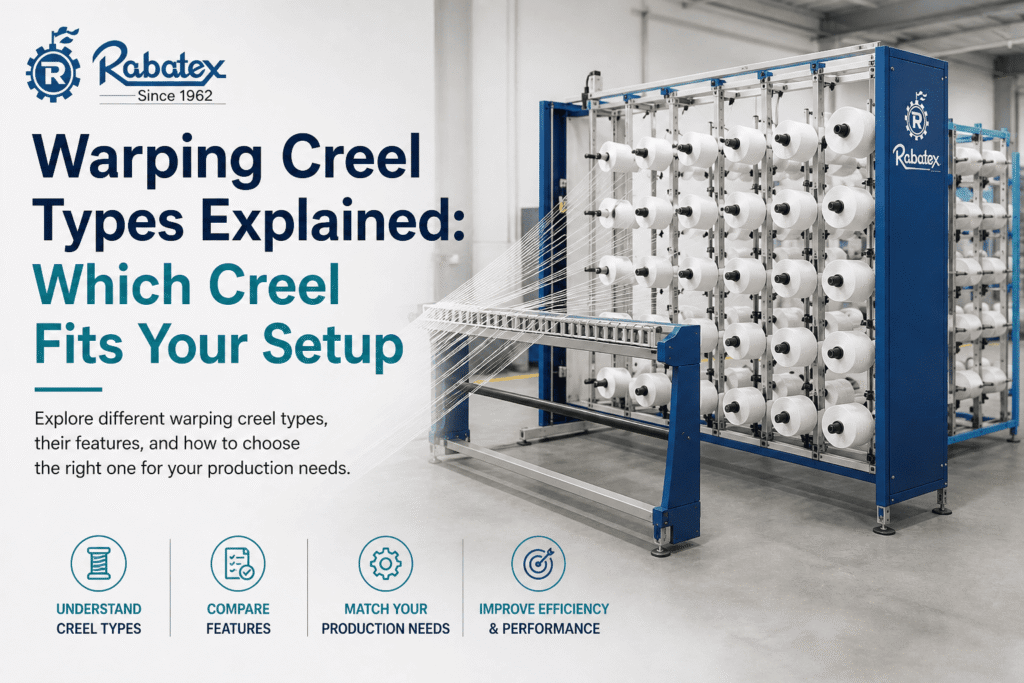
Imagine it’s a Tuesday morning in a weaving mill. The warping machine is ready, the beam is waiting, and the order is due by Friday. Then a cone runs out on the third deck of the creel, right at the far end. The operator walks the length of the creel, stretches to reach the empty spindle, swaps the package and threads the end again. Ten minutes later another cone runs out, and a broken end somewhere along the row goes unnoticed until the beam shows it.
The warping machine ran all morning perfectly. The delay sat at the creel, and the production manager is left wondering whether a different creel would have made the shift easier. Maybe one where the frame swivels and the packages come to the operator. Maybe one where the next set of cones is already loaded on a trolley and waiting.
If you run a weaving mill, manage production, supervise warping or buy machinery, you may have lived some version of that morning. A Parallel H creel, a swivel frame creel and a Parallel Trolley Type H creel all feed yarn to the warping machine, yet each one arranges the packages, gives access to them and handles replacements in its own way. This guide walks you through all three, so the next creel you choose fits the way your mill actually works.
What Are the Different Types of Warping Creels and How Do They Differ
A warping creel holds the yarn packages that feed the warping machine. Every creel does that basic job, but the way each one does it changes your daily routine. Three configurations cover most of what mills ask for.
RI 201
Parallel H Creel. Packages sit in an organised, fixed arrangement, and yarn is drawn from them in a steady, controlled way. The conventional choice for many mills.
RI 202
Swivel Frame Creel. The frames can rotate, so packages come to the operator instead of the operator walking to the packages.
RI 203
Parallel Trolley Type H Creel. Packages are loaded on trolleys, so your team can prepare the next set while the current set is still running.
The real differences show up in three places. The first is how the packages are arranged. The second is how easily an operator can reach them. The third is how much effort it takes to replace a package when it runs out. Keep those three questions in mind as you read each option below.
Remember
Creel design is only half the story. The quality of the components inside it, such as tensioners, stop motion units and yarn guides, decides whether the creel runs reliably day after day or becomes a regular source of stoppages.
How a Parallel H Creel Works and When It Makes Sense for a Warping Setup
In a Parallel H creel, yarn packages are mounted on fixed frames arranged in rows and levels. Each package feeds one yarn end, and those ends travel through tensioners and guides before they reach the warping machine. Think of it as a well-organised library shelf where every package has a fixed place and every end has a defined path.
Here is what to look at when you evaluate this arrangement.
- Package arrangement and accessibility. Packages are placed in rows, so each one is easy to identify. Operators work along the creel to reach them. This works well when the aisles are comfortable and the package count is manageable.
- Yarn withdrawal. Yarn is drawn off each package in a consistent direction, which helps keep the withdrawal smooth. A mill running cotton cones, for example, benefits from this steady and predictable draw.
- Tensioning and stop motion. Each end passes through a tensioner so the sheet reaches the machine with even tension. A stop motion unit picks up a broken end so the operator can fix it quickly instead of discovering it on the beam later.
- Operator handling. Operators walk the creel to load, replace and monitor packages. The routine is simple and easy to train, though reaching the higher levels takes more effort than the lower ones.
- Available space and layout. A Parallel H creel needs a clear footprint with room for aisles on the operating side. If your warping section has a straight run of floor space, this layout slots in naturally.
Rabatex RI 201 Parallel H Creel for Different Warping Requirements
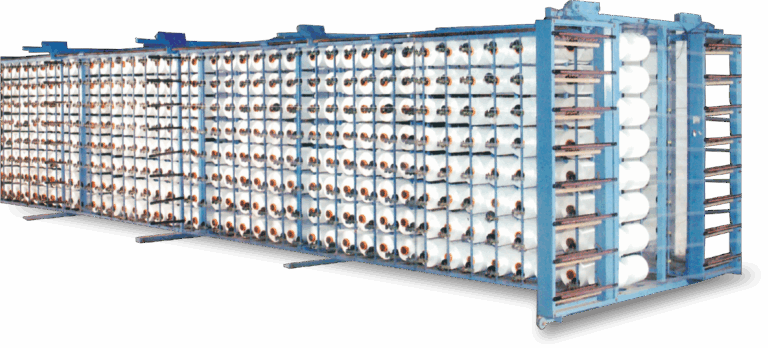
RI 201
Our RI 201 is built for mills that want a dependable, conventional package arrangement without extra complexity.
Where it can be used
- Warping setups needing a Parallel H arrangement. If your existing process and operator habits are built around a fixed H layout, the RI 201 fits in without changing how your team works.
- Weaving mills handling many yarn packages. A mill supplying several looms from one warping section needs an arrangement where hundreds of packages stay organised and easy to trace.
- Setups where a conventional arrangement suits the job. Not every operation needs moving frames or trolleys. When yarn changes are infrequent and packages are handled in planned batches, a fixed arrangement does the job well.
- New setups and expansions. A mill adding a second warping line can plan the RI 201 as part of the layout from day one instead of squeezing a creel in later.
What challenges it can help address
- Managing a large number of packages. Rows and levels keep packages in a clear order, so an operator can find the right one without searching.
- Controlled yarn supply. Tensioners help keep yarn feeding evenly into the warping process, which supports a uniform sheet.
- Spotting yarn breaks. The stop motion flags a broken end, so the problem is caught at the creel instead of showing up as a defect later.
- Different capacity needs. Creel capacity and configuration can be matched to the number of ends your warping job requires.
- Practical package access. The layout is designed so operators can handle packages during routine work without awkward reaching or crowding.
Configuration and technical features
The RI 201 is built on an MS tube fabricated structure with a manually withdrawable tensioner frame, and yarn is drawn off from outside to inside. The details below help you check the fit for your yarn and number of ends.
| Feature | Specification |
|---|---|
| Structure | MS tube fabricated, manually withdrawable tensioner frame |
| Yarn withdrawal | Outside to inside |
| Standard ends | 320, 400, 480, 560, 640, 720, 800, 880, 960 or 1200 ends |
| Standard pitch | 280 mm, both vertical and horizontal. 200, 280, 300 or 350 mm available on request |
| Vertical decks | Eight decks as standard; optional 5, 6, 7, 8, 10 or 12 |
| Cone holder | Spindle fixed type |
| Tensioner type | Ratchet type or Tiana type |
| Stop motion | Optical type |
| Eyelet | Ceramic eyelet, closer or open type |
| Optional accessory | Overhead cleaner |
If you are unsure which number of ends, pitch or deck count suits your yarn and package, share the details with us and we will help you narrow it down.
How a Swivel Frame Creel Works and When Easier Package Access Matters
A swivel frame creel keeps the same basic idea of a fixed creel but adds one big change. The frames can rotate on a pivot. Instead of walking down a long row to reach packages at the far end, the operator turns the frame and brings the packages into easy reach.
A simple way to picture it is a revolving door. You stay where you are, and the thing you need comes to you.
- Swivel frame operation. Frames rotate on a pivot, which opens up the packages on the inside of the creel. Operators can reach spots that would be hard to get to on a fixed frame.
- Package accessibility. Packages that would sit deep inside a fixed arrangement become easy to see and touch. This helps when your operators handle heavy packages or work long shifts.
- Package replacement. Swapping an empty package for a full one is quicker when the frame is turned to the operator. There is less bending, stretching and carrying across the floor.
- Operator movement. Operators walk less. Over a full shift, across several creels and hundreds of packages, that saved walking adds up to real time and less fatigue.
- Tensioning and stop motion. Each end still runs through its tensioner and stop motion, so yarn control stays intact while the frame arrangement makes the packages easier to reach.
- Space around the creel. A swivel frame needs clearance so the frame can rotate. You should plan that turning space into the layout around the creel.
Rabatex RI 202 Swivel Frame Creel for Easier Package Handling

RI 202
Our RI 202 is designed for mills where the people handling the yarn matter as much as the yarn itself.
Where it can be used
- Setups where operator access matters. If your team complains about reaching packages on the upper or inner levels, the RI 202 addresses that directly.
- Operations with regular package handling. A mill running frequent yarn changes, short production runs or many different warps will touch its packages more often than a mill running one long warp for weeks.
- Setups where convenience improves daily work. Take a warping section with mixed shifts and operators of different heights and experience. A swivel arrangement makes the work more comfortable and easier to repeat.
- Mills moving away from hard to reach fixed frames. If your current creel has packages that are awkward to load, the RI 202 offers a way to improve access without changing the rest of your process.
What challenges it can help address
- Difficult access to yarn packages. Rotating the frame brings hard to reach packages within easy reach.
- Operator movement around a fixed frame. Less walking and less climbing around the creel during loading.
- Package replacement and handling. Changing packages becomes a more comfortable task.
- Monitoring many yarn ends. With packages easier to see, operators spot a broken or running out end faster.
- Keeping packages organised. Even with rotation, the packages stay in a clear, orderly arrangement.
Configuration and technical features
The RI 202 is built on an MS tube fabricated structure with a manually withdrawable tensioner frame. Yarn is drawn off from outside to inside, and the stop motion gives row wise indication so your operator can see which row has a break.
| Feature | Specification |
|---|---|
| Structure | MS tube fabricated, manually withdrawable tensioner frame |
| Yarn withdrawal | Outside to inside |
| Standard ends | 320, 400, 480, 560, 640, 720, 800, 880, 960 or 1200 ends |
| Standard pitch | 280 mm, both vertical and horizontal. 200, 280, 300 or 350 mm available on request |
| Vertical decks | Eight decks as standard; optional 5, 6, 7, 8, 10 or 12 |
| Cone holder | Spindle swivel type |
| Tensioner type | Ratchet type or Tiana type |
| Stop motion | Optical type with row wise indication |
| Eyelet | Ceramic eyelet, closer or open type |
| Reserve package holder | Provided in line with the creel capacity |
| Optional accessory | Static eliminator on the stop motion |
Ends, pitch and deck count can all be matched to your yarn, package size and available floor space. Share your yarn and layout details with us and we can suggest the arrangement that suits you.
How a Parallel Trolley Type H Creel Works and When Flexible Package Handling Helps
A trolley creel changes where the package preparation happens. Instead of loading every package directly onto the creel, your team loads packages onto trolleys, often away from the creel itself. The trolley is then moved into position and connected to the creel.
Think of how a restaurant kitchen works. The cooks do not prepare every plate at the table. They prepare it in the kitchen and bring it out ready. A trolley creel works on the same idea.
- Trolley based package arrangement. Packages are held on trolleys that sit within the H arrangement. The trolley is the unit you move, not the individual package.
- Package loading and replacement. Loading happens at a comfortable working position, away from the running creel. When a set of packages runs out, you replace the entire trolley instead of changing packages one by one on the creel.
- Spare package handling. Spare trolleys can be loaded in advance. While one set is running, the next set waits ready, which cuts the waiting time between warps.
- Operator movement. Operators prepare packages at a convenient spot, so they spend less time climbing around the creel with heavy cones in their hands.
- Space and workflow. A trolley creel needs room to move trolleys in and out and a place to stage the spares. The layout should plan that path before the machine is installed.
A useful comparison is a relay race. The next runner is already in position when the baton arrives, so there is no pause for the handover.
Rabatex RI 203 Parallel Trolley Type H Creel for Flexible Package Handling

RI 203
Our RI 203 is made for operations where package preparation and replacement take a big share of the working day.
Where it can be used
- Warping setups where preparation and replacement matter. If your team spends a lot of time getting packages ready between warps, the RI 203 gives that work a better structure.
- Textile and weaving operations needing a trolley arrangement. Mills that run multiple warps in a shift benefit from loading the next set while the current one is running.
- Environments where flexible handling helps. A mill that changes yarn counts or lots often can keep different yarns ready on separate trolleys and switch between them as needed.
- Mills that want to reduce idle time between warps. The spare trolley provision supports a smoother changeover.
What challenges it can help address
- Time and effort handling packages. Loading on trolleys at a comfortable position reduces the strain of loading directly on the creel.
- Managing replacement packages. Spare trolleys hold the next set ready, so replacements are always at hand.
- Moving packages into position. The trolley carries the whole set into place instead of carrying packages one by one.
- Organising package handling around the warping operation. Preparation and running happen side by side, which keeps the workflow tidy.
- A smoother operator workflow. Operators follow a clear routine of load, move and connect, which is easy to teach to new team members.
Configuration and technical features
The RI 203 is built on an MS tube fabricated structure with a manually withdrawable tensioner frame, and yarn is drawn off from outside to inside. Cones sit on spindles in trolley form, and a spare trolley is provided as the reserve package holder.
| Feature | Specification |
|---|---|
| Structure | MS tube fabricated, manually withdrawable tensioner frame |
| Yarn withdrawal | Outside to inside |
| Standard ends | 320, 400, 480, 560, 640, 720, 800, 880, 960 or 1200 ends |
| Standard pitch | 280 mm, both vertical and horizontal. 200, 280, 300 or 350 mm available on request |
| Vertical decks | Eight decks as standard; optional 5, 6, 7, 8, 10 or 12 |
| Cone holder | Spindle in trolley form |
| Reserve package holder | Spare trolley provided |
| Tensioner type | Centrally adjustable, so all tension units can be adjusted together, manually or motorised |
| Stop motion | Optical type with row-wise indication |
| Eyelet | Ceramic eyelet, closer or open type |
| Optional accessories | Individual tensioner with individual sensor (imported), overhead travelling cleaner, individual air nozzles, tension bridging device, static eliminator on the creel stop motion |
The trolley arrangement, the trolley-form cone holders and the spare trolley work together so that preparation and production overlap instead of waiting on each other.
How RI 201, RI 202 and RI 203 Compare for Different Warping Requirements
The table below gives you a quick view of how the three creels differ on the points that usually drive the decision.
| Selection factor | RI 201 | RI 202 | RI 203 |
|---|---|---|---|
| Creel configuration | Parallel H | Swivel frame | Parallel trolley type H |
| Package handling | Conventional arrangement | Swivel frame access | Trolley-based handling |
| Package accessibility | Fixed arrangement | Rotating frame | Trolley arrangement |
| Key consideration | Organised package arrangement | Easier package access | Flexible package handling |
| Useful when | Conventional H setup is suitable | Access is a key concern | Package movement and replacement need flexibility |
A table only gets you so far, so here is how the choice tends to play out on a real shop floor.
Choose the RI 201 when your process is steady and planned.
Trolley Type H Creel Our RI 203 is made for operations where package preparation and replacement take a big share of the working day.
Choose the RI 202 when your operators are the bottleneck.
If packages are heavy, levels are high or your team struggles to reach the inside of the creel, rotating the frame solves a daily annoyance. The gain shows up in comfort, speed of replacement and fewer awkward movements.
Choose the RI 203 when time between warps is what hurts.
If your mill changes warps often and operators spend too long preparing packages with the machine standing idle, a trolley arrangement lets preparation happen in parallel. The gain shows up in shorter changeovers.
Many mills find that one of these three questions gives them the answer within a few minutes. If you answer yes to more than one, that is a good point to talk through your setup in detail.
What Should You Consider Before Choosing a Warping Creel
Before you settle on a creel, walk through the following points. Each one can tip the decision.
- Yarn type and package format. A fine-spun yarn on small cones behaves differently from a heavy filament on large packages. Package size and weight affect how comfortable manual loading is and which arrangement makes sense.
- Number of ends and creel capacity. Your warp needs a certain number of ends, and the creel must hold enough packages to supply them. Settle this number early because it shapes the size of the whole creel.
- Available space around the warping machine. Measure the floor, the aisles and the turning or trolley movement space. A creel that looks perfect on paper can fail if operators cannot move around it. If you are setting up a new facility or expanding production, treat the creel as part of the wider machine and production layout instead of an afterthought. We can help you plan this, whether you are setting up new premises or expanding an existing section.
- Package loading and replacement. Watch how your operators load and replace packages today. If this takes a large share of their shift, the arrangement you pick will matter a lot.
- Tensioning and yarn break monitoring. Even tension keeps the warp sheet uniform, and good stop motion shows you a broken end the moment it happens. Together they protect the quality of what goes onto the beam.
- Component quality and machine performance. The parts inside the creel decide how it behaves over years of use. Good components support reliable performance, consistent operation, better efficiency and a longer service life. This is why we use components from Japanese and European technology brands where appropriate, and work with global suppliers for key components. A creel built on dependable parts gives your team fewer surprises and fewer unplanned stops.
- Compatibility with the complete warping setup. The creel works together with the warping machine, the yarn package and your production targets. Choosing it in isolation is how mills end up with a mismatch.
This last point is where an experienced machine builder helps. We work as solution providers. We start by understanding your requirements, then explain how the machine and creel will work together and what output you can realistically expect from them. Educating customers on this is a big part of how we work, because a buyer who understands the output makes a better decision. You get a recommendation based on your actual setup instead of a catalogue pick.
Which Warping Creel Fits Your Setup
The right creel is the one that matches your actual warping setup. Start from your yarn and package type, count your ends, measure your space, watch how your operators handle packages and be clear about your production needs. Those five inputs usually point to one of the three options quickly.
Rabatex has been building textile machinery for more than 60 years, and that experience shapes how we approach a creel enquiry. Corporates across India run our machines, and we are export ready, so mills outside India get the same attention. As a customer centric company, we begin by understanding what your mill needs to produce, then recommend a configuration that fits. We also help you understand the output you can expect from the machine, and we support you with service after installation so the setup keeps running the way it was planned.
If you are planning a new warping line, expanding an existing one or rethinking the creel you have today, you can share your yarn details, number of ends and available space with us. We will talk through your requirements and help you choose the creel that suits your setup. Contact us today!
FAQs
What are the main types of warping creels?
Three configurations are commonly used. The Parallel H creel holds packages in a fixed, organised arrangement. The swivel frame creel uses rotating frames that bring packages to the operator. The parallel trolley type H creel uses trolleys so packages can be loaded away from the creel and moved into place. We offer all three as the RI 201, RI 202 and RI 203.
What is a Parallel H Creel?
A Parallel H creel is a fixed creel where yarn packages are mounted in rows and levels in an H arrangement. Each package feeds one yarn end, which passes through a tensioner and stop motion before reaching the warping machine. It suits setups that want a conventional, organised package layout.
What is a swivel frame creel?
A swivel frame creel has frames that rotate on a pivot. Turning the frame brings packages within easy reach, which makes loading and replacing packages more comfortable. It suits warping setups where operator access to packages is an important concern.
What is a Parallel Trolley Type H Creel?
This creel holds packages on trolleys placed within the H arrangement. Your team can load packages onto spare trolleys in advance, then move a ready trolley into position when needed. It suits operations that want preparation and production to happen side by side.
How do I choose the right warping creel?
Start with your yarn and package type, the number of ends you need, the space around the warping machine and the way your operators handle packages. If your process is steady, a Parallel H creel often works. If access is a problem, look at a swivel frame. If changeover time hurts, a trolley arrangement is worth a close look.
What challenges can the right creel help address?
A well matched creel can help with managing large numbers of packages, keeping yarn supply controlled, spotting yarn breaks quickly, making package access practical and reducing the time and effort spent loading and replacing packages.
What should I consider when selecting a creel for a warping machine?
Look at yarn type and package format, number of ends and creel capacity, available floor space, how packages are loaded and replaced, tensioning and stop motion, component quality and how well the creel fits the complete warping setup.
Why does component quality matter in a warping creel?
Tensioners, stop motion units and yarn guides work all day, every day. Better components support reliable performance, consistent operation, good efficiency and a longer service life. We use components from Japanese and European technology brands where appropriate and work with global suppliers for key components.
How can a textile machinery manufacturer help with a new warping setup?
An experienced manufacturer can look at your yarn, ends, space and production targets, then recommend the machine and creel configuration that fits. We also help customers understand the output they can expect and provide service support after installation.
About the Rabatex Process Engineering Team
The Process Engineering Team at Rabatex designs, builds and commissions warping machines, creels and vertical lift modules for textile mills and industrial warehouses. Based in Ahmedabad, the team brings the experience of a manufacturer that has been building machinery since 1962.
Related Posts
What Is a Vertical Lift Module? A Complete Guide to VLM Storage Systems
Walk into almost any textile manufacturing facility, and you’ll notice
How to Choose the Right Sectional Warping Machine for Your Textile Mill
“The loom has stopped again.” No production manager wants to

How Apparel Manufacturers Speed Up Fabric Development with Sample Warping Machines
“Can we see two more fabric options before we finalize