
If you work with monofilament yarn, you already know that preparing the yarn for weaving is not simply a matter of winding it onto a beam. The way the yarn is split, arranged, tensioned, warped and finally beamed can influence the consistency of the warp and the efficiency of the downstream weaving process.
This becomes even more important when your raw material is mother yarn that needs to be split into individual monofilament ends before it can be used for fabric production.
For a weaving mill, this creates an important production decision. Should you use a conventional route where mother yarn is split first and then processed through separate warping and beaming stages? Or would a sectional split warping process that combines splitting and sectional warping into a more streamlined workflow be better suited to your production?
The answer depends on your yarn, package configuration, fabric program, beam requirements, available floor space and production volumes.
This guide explains how monofilament yarn moves from mother yarn to a weaving beam, how different split warping methods compare, and what textile manufacturers in India should consider before selecting a machine.
What Is Monofilament Yarn and How Is It Used?
Monofilament yarn is made from a single continuous filament. This is different from multifilament yarn, where several fine filaments are grouped together to form one yarn.
Polyester and nylon are commonly used for monofilament applications, although the required yarn characteristics vary depending on the fabric and end use.
Monofilament yarn can be used in woven fabrics, mesh, technical textiles, industrial fabrics and other specialised textile applications. The yarn specification, including denier, material and filament characteristics, can affect how it needs to be prepared for weaving.
For example, a mill producing a lightweight woven fabric may work with 20D polyester or nylon monofilament. The mill then needs to arrange the required number of these individual ends across the working width and prepare them into a beam that can be taken forward to weaving.
This is why choosing a suitable monofilament warping machine is not only about handling the yarn. The machine and process also need to match the final fabric and beam requirements.
Why Does Monofilament Yarn Need Careful Warp Preparation?
When you prepare thousands of individual monofilament ends for weaving, consistency across the warp becomes important.
The yarn needs to be presented in the required arrangement and prepared according to the beam specification. If the production process involves unnecessary handling or additional intermediate stages, it can also increase the movement of yarn packages around the plant.
For example, if a weaving mill regularly produces 58-inch and 64-inch fabrics using similar monofilament yarn, the warping process needs to accommodate those different production requirements rather than being designed around only one standard beam.
This makes the complete yarn-to-beam process an important part of machine selection.
What Is Mother Yarn and Why Does It Matter in Monofilament Warping?
Mother yarn is a larger multifilament package that can be processed to separate its individual filaments and prepare them as monofilament yarn.
The relationship between the mother yarn and the resulting monofilament can be understood through a simple example.
Suppose the mother yarn is 200D/10F. The total denier is 200 and the yarn contains 10 filaments. If those filaments are separated, each individual filament is approximately:
200D ÷ 10 = 20D
Similarly, a 240D/12F mother yarn can produce individual filaments of approximately 20D.
The actual yarn specification and production process should always be confirmed, but the example shows why mother yarn construction matters.
Why Does the Mother Yarn Format Affect the Warping Process?
The mill does not simply transfer mother yarn from one package to another. In the conventional process, mother yarn packages are first loaded onto Specific splitting machines (Split winders). The mother yarn is then separated into individual monofilament ends and wound into smaller mono yarn packages or cops.
These individual mono packages then need to be collected, handled and loaded onto a separate creel before they can be processed on a sectional warping machine.
The conventional production flow can therefore involve:
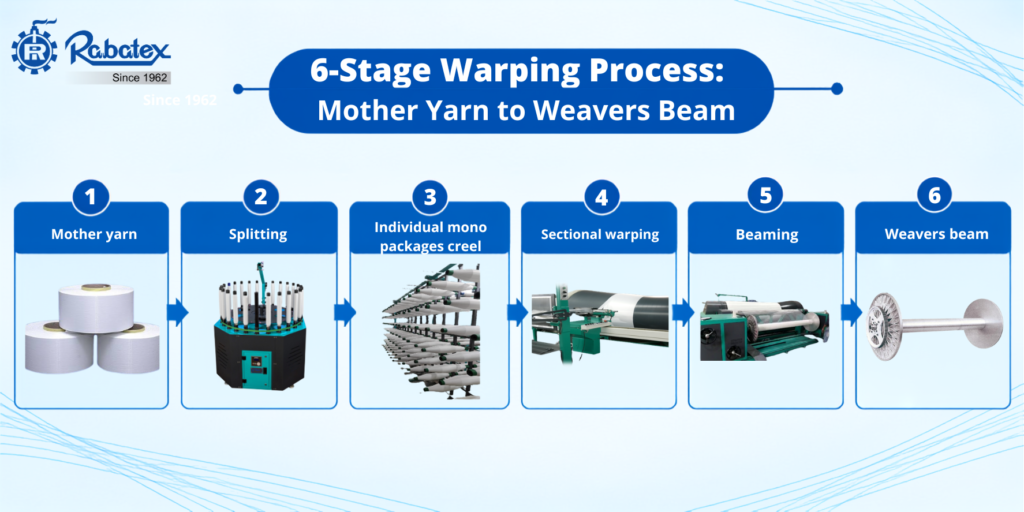
Each additional stage adds time and material handling to the production process. The intermediate mono packages have to be unloaded, moved, stored or staged when required, and then loaded again onto the sectional warping creel. Repeated handling can also increase the chances of package damage, yarn contamination, tension variation or other inconsistencies that can affect warp preparation.
For mills processing large quantities of mother yarn, these additional activities can make the overall production flow more time-consuming and increase the effort required from operators.
A purpose-built monofilament yarn warping machine can instead be selected around the way the mother yarn is being prepared and the final beam required, allowing splitting and sectional warping to be handled as part of a more integrated process.
What Happens If Intermediate Packages Are Required?
Imagine a mill processing a large quantity of mother yarn every day.
After splitting, the individual mono yarn packages need to be collected and moved to the next machine. They may also need temporary storage if the splitting and warping schedules do not match.
This creates another layer of production planning.
A more integrated sectional split process can reduce some of these intermediate activities by bringing mother yarn splitting and sectional warping into the same production route.
How Does Monofilament Yarn Become a Weaving Beam?
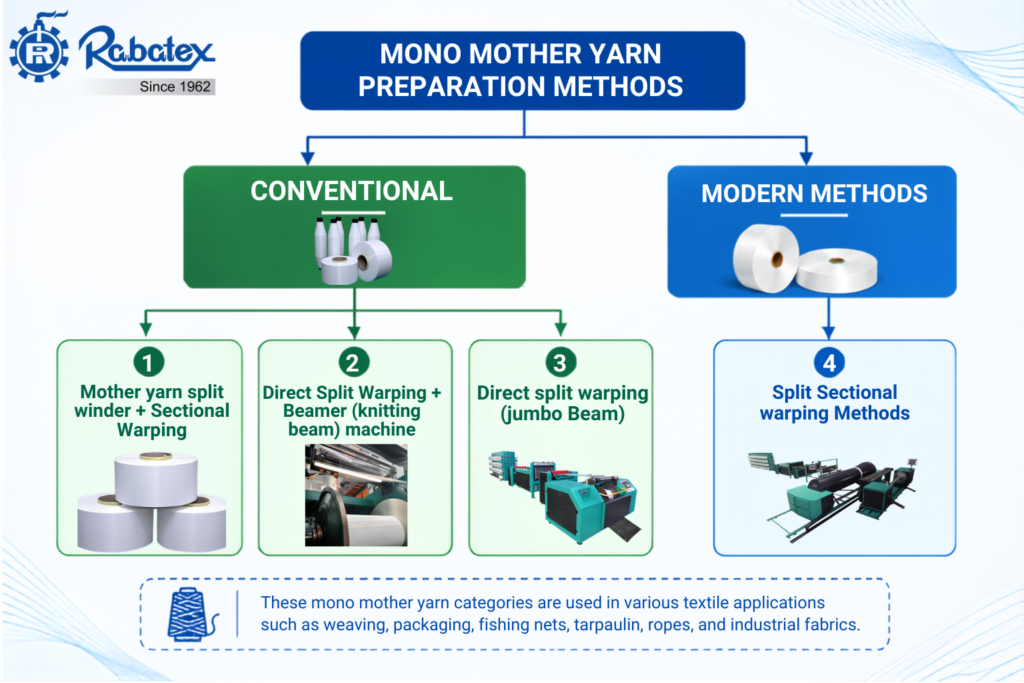
There is more than one way to move from mother yarn to a finished weaving beam.
The right method depends on the yarn, required working width, beam dimensions, fabric program, production volume and machinery already available in the mill.
Let’s look at the main routes.
One Option Is to Split the Mother Yarn Before Sectional Warping
In this conventional route, mother yarn first goes through a split winding operation.
The individual filaments are separated and wound into smaller packages. These prepared packages are then taken to a sectional warping machine, where the warp is built section by section.
After sectional warping, the prepared material is taken through the required beaming process to produce the final weavers beam.
Why Would a Mill Choose This Conventional Route?
One reason is that the mill may already have separate splitting and warping equipment.
If the existing production line is working effectively, replacing the complete process may not always be necessary. However, the manufacturer should consider the additional package handling and floor-space requirements associated with the separate stages.
For example, a mill may have enough capacity on its split winding machines but experience delays because prepared packages accumulate before the sectional warping machine is ready to process them.
In such a situation, the bottleneck may not be the warping machine itself. It may be the way the complete process is organised.
For Smaller Beams, Mother Yarn Can Be Split and Warped Directly
Another route involves splitting and warping mother yarn directly into a smaller or knitting-related beam.
The general process can look like:
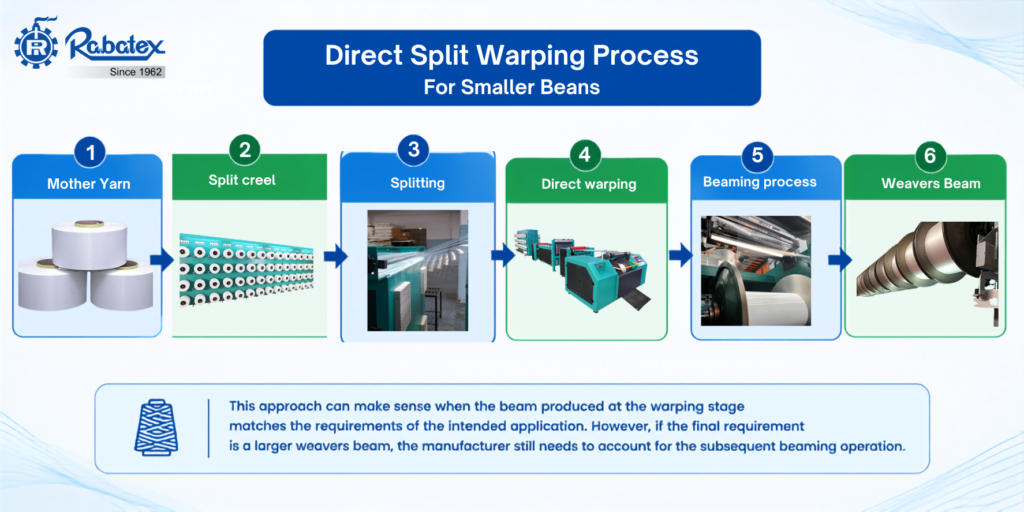
This approach can make sense when the beam produced at the warping stage matches the requirements of the intended application.
However, if the final requirement is a larger weavers beam, the manufacturer still needs to account for the subsequent beaming operation.
That is why comparing only the first beam produced by the machine can give an incomplete picture of the production process.
For Larger Requirements, Direct Split Warping Can Be Used for Jumbo Beams
Mother yarn can also be split and warped directly onto a larger or jumbo beam.
The warped material can then be processed through beaming to create the required weavers beam.
This approach can be useful where the production setup is designed around larger beam formats.
However, the mill still needs to evaluate the complete material flow, including beam handling, storage, machine loading and downstream beaming.
Sectional Split Warping Combines Splitting and Sectional Warping
Sectional split warping takes a more integrated approach. Instead of first splitting the mother yarn on a separate creel and then creating individual mono yarn packages, the mother yarn is fed directly into the motorised split creel of the sectional split warping machine.
For example, if 120 mother yarn packages are loaded onto the split creel, the splitting arrangement can separate the filaments from these packages and provide the required individual monofilament ends for sectional warping. Depending on the mother yarn construction and splitting configuration, the number of resulting monofilament ends can be higher than the number of mother yarn packages.
The separated monofilament yarn is then warped section by section and the prepared sections are combined and beamed into the required weavers beam.
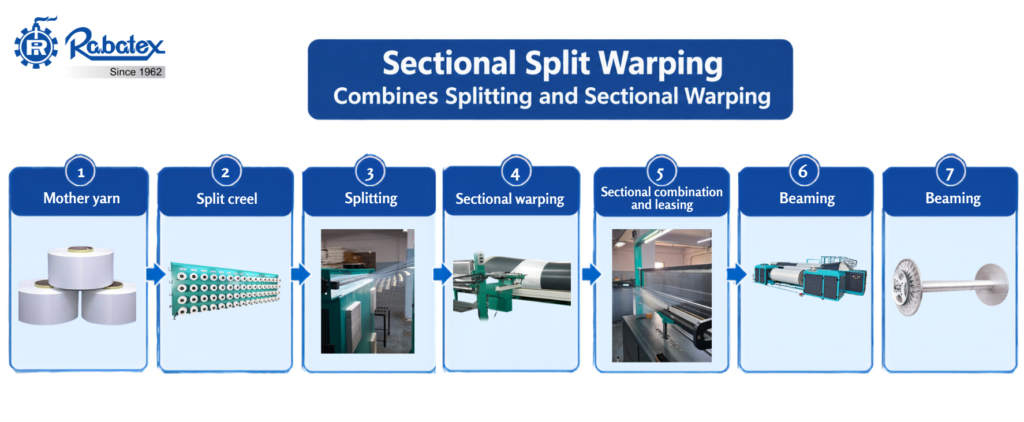
This integrated process can save time because the intermediate step of creating, unloading, moving and reloading separate mono yarn packages can be avoided. It also simplifies yarn handling because the yarn moves directly from the mother yarn packages into splitting and sectional warping.
Fewer intermediate handling stages can also help maintain more consistent yarn conditions by reducing the number of times the yarn packages need to be handled, moved and loaded between machines.
The key difference is the way the production stages are brought together. Instead of creating separate intermediate mono packages before sectional warping, the process moves more directly from mother yarn splitting to sectional warping.
How Does Direct Split Warping Compare With Sectional Split Warping?
For a textile manufacturer, this comparison is less about choosing one machine name over another and more about comparing two production flows.
A procurement team may initially look at machine speed, working width and price.
A production manager should also ask:
- How many processing stages are involved?
- How many times does the yarn need to be handled?
- Are intermediate packages or beams required?
- How much floor space is required?
- How much manpower is needed across the complete process?
- How easily can the system handle changing fabric programs?
| Parameter | Direct Split Route | Sectional Split Route |
| Basic process | Mother yarn is split and prepared through a direct warping route | Mother yarn is split and warped section by section |
| Intermediate handling | May involve intermediate small or jumbo beam handling depending on the setup | Can reduce intermediate handling in the described process |
| Sectional warping | Separate stage where applicable | Integrated into the sectional split process |
| Leasing | May require a separate operation depending on setup | Can form part of the sectional operation |
| Production flexibility | Depends on beam and machine configuration | Can support different program requirements from the same creel |
| Floor space | May increase when additional equipment and intermediate storage are required | More streamlined process can reduce intermediate handling space |
| Manpower | More separate stages can increase material movement | Fewer separate processing stages can simplify material movement |
| Investment | May require multiple machines for splitting and subsequent processing | Can combine parts of the process into one system |
| Suitability | Depends strongly on the existing mill setup | Relevant when reducing intermediate processing is a priority |
| Usage | These beams are prepared specifically for Warp Knitting Machines Only (popularly known as flat knitting ) | Beams prepared in this machines can be used in looms like Airjet, Waterjet, Rapier Jacquard & conventional looms |
The comparison does not mean that sectional split warping is automatically the better choice for every mill.
A manufacturer with an established conventional setup may find that its existing process already meets its production requirements.
The important question is whether the complete production route gives you the required combination of output, flexibility, manpower efficiency and material handling.
Why Can a Sectional Split Warping Machine Make Sense for Monofilament Yarn?
The main advantage of sectional split warping is the potential to simplify the complete journey from mother yarn to weaving beam.
You Can Reduce Intermediate Processing Between Splitting and Warping
When mother yarn is split separately, the resulting monofilament packages may need to be prepared and moved before sectional warping begins.
An integrated sectional split process can reduce the need for this intermediate stage.
For a mill processing substantial yarn volumes, this can make the production flow easier to manage.
You Spend Less Time Moving Intermediate Yarn Packages
Material handling is an important part of textile production that can easily be overlooked during machinery selection.
A package may need to be removed from one machine, transported to a storage or staging area and then loaded onto another machine.
When this happens repeatedly across multiple shifts, the total handling effort can become significant.
A more integrated process can reduce some of these movements.
You Can Make Better Use of Available Factory Floor Space
The space required for a production process is not limited to the machine footprint.
A conventional setup may also require space for:
- Intermediate packages
- Beam storage
- Material staging
- Operator movement
- Loading and unloading
For example, a mill with limited available space may find that removing an intermediate package-handling stage creates more useful production space even when the main machine footprint remains similar.
You Get More Flexibility When Production Programs Change
Weaving mills often produce different fabrics based on customer requirements.
One production program may require a 58-inch fabric while another may require a 64-inch fabric. The yarn may also change between polyester and nylon monofilament.
A sectional process that can be configured around different production requirements can therefore be useful for mills that do not operate a single fixed production program.
You Can Simplify Material Handling Across the Process
Fewer separate operations can mean fewer points where yarn packages need to be moved and manually handled.
This does not remove the need for trained operators. Instead, it can change where operator time is spent by reducing some of the repetitive movement between separate machines.
You Can Evaluate Potential Cost Savings Across the Complete Production Flow
The purchase price of a machine does not tell you the complete cost of production.
For example, one setup may involve separate splitting equipment, intermediate package handling, additional storage and more operator movement.
Another setup may integrate more of these stages.
The right comparison should therefore include equipment, manpower, floor space, material handling, machine utilisation, maintenance and other operating costs relevant to your plant.
How Does a Sectional Split Warping Machine Work?
The easiest way to understand a sectional split warping machine is to follow the yarn from the first package to the finished beam.
The Process Starts With Feeding Mother Yarn From the Split Creel
Mother yarn packages are positioned on the split creel and prepared for controlled feeding.
The creel configuration is important because it determines how the yarn packages are presented to the machine.
The exact arrangement depends on the machine configuration and the production requirement.
For example, a mill handling a particular mother yarn package format may need a different creel arrangement from a mill using another package configuration.
The Mother Yarn Is Split Into Individual Monofilament Ends
The mother yarn is separated into individual filament ends.
Using the earlier example, 200D/10F mother yarn contains 10 filaments within a total 200D yarn construction. When separated, each filament is approximately 20D.
At this point, the larger mother yarn package has effectively been converted into the individual monofilament ends required for warp preparation.
The Separated Yarn Is Warped Section by Section
The separated monofilament ends are arranged into sections.
Instead of attempting to prepare the entire warp width in one operation, sectional warping builds the warp progressively.
Each section is wound according to the required warp plan.
For example, if a particular fabric requires a defined number of warp ends across its working width, those ends can be organised into sections according to the machine and production configuration.
This sectional approach is one of the fundamental characteristics of sectional warping.
The Prepared Sections Are Combined and Leased
After the required sections have been prepared, they are brought together.
Leasing helps maintain the required yarn order and separation so that the warp can be managed correctly during subsequent processing and weaving.
In a sectional split setup, the leasing process can form part of the integrated operation rather than being treated as an entirely separate downstream activity.
The Completed Warp Is Converted Into a Weavers Beam
The final stage is beaming.
The prepared warp is combined and wound into the required weavers beam.
This is the output that moves forward to the weaving stage.
Therefore, when evaluating a sectional split warping machine, it is useful to look beyond the number of metres warped per minute.
The real objective is to produce a consistent warp beam that meets the requirements of the weaving process.
How Does 200D/10F Mother Yarn Become 20D Monofilament?
A simple yarn example makes the splitting concept easier to understand.
Suppose your mill receives 200D/10F polyester mother yarn.
The yarn has:
- Total denier: 200D
- Number of filaments: 10
The approximate denier of each individual filament is:
200D ÷ 10 filaments = 20D per filament
Once separated, these individual 20D filaments can be prepared for the intended textile application.
The next challenge is preparing the required number of these monofilament ends into a warp.
For example, if the fabric requires a particular working width and warp construction, the individual ends need to be arranged accordingly before they can become part of the final weavers beam.
This illustrates why mother yarn splitting and warping should be considered as connected processes rather than completely separate activities.
Where Can Monofilament Yarn Be Used in Woven Fabrics?
Monofilament yarn can be used in different fabric constructions and applications depending on the yarn material and specification.
The supplied production data includes examples using polyester and nylon monofilament in fabrics such as Chanderi, Berlin, Goldy Silk, Roman Silk, Lehriya, Fandy Chiffon and Fandy Satin.
Some representative examples include:
| Fabric Example | Width | Warp Material | Weaving Type |
| Chanderi | 64″ | 20D SD Polyester Mono | Plain |
| Berlin | 62″ | 20D SD Polyester Mono | Plain |
| Goldy Silk | 58″ | 20D Gold Polyester Mono | Plain |
| Roman Silk | 64″ | 20D SD Nylon Mono | Dobby / Plain |
| Lehriya | 64″ | 20D SD Nylon Mono | Plain |
| Fandy Chiffon | 58″ | 20D BRT Nylon Mono | Plain |
| Fandy Satin | 58″ | 20D SD Nylon Mono | Plain |
These examples also show why the fabric program matters when selecting a warping machine.
A 58-inch fabric and a 64-inch fabric have different width requirements. Similarly, different fabric constructions can create different warp preparation requirements.
The machine should therefore be evaluated against the actual fabrics your mill produces or plans to produce.
How Does Sectional Split Warping Fit Indian Textile Mills?
The process can be particularly relevant to textile manufacturers operating in India’s large synthetic yarn and weaving ecosystem.
Surat, for example, has a significant concentration of synthetic textile manufacturing and weaving activity. Mills operating in such an environment may need to respond quickly to changing fabric programs, customer requirements and production quantities.
However, the application is not limited to Surat.
Weaving mills and technical textile manufacturers across India can evaluate sectional split warping based on their own yarn preparation requirements.
This Process Can Suit Mills Handling Multiple Fabric Programs
If your mill produces several fabric designs instead of one fixed product, the flexibility of the warping system becomes important.
For example, one customer order may require 20D polyester monofilament for a 58-inch fabric, while another may require a different configuration for a wider fabric.
The machine selection should account for these changes rather than being based only on today’s most common production order.
It Can Also Help Where Intermediate Handling Is a Concern
If your existing process involves significant movement of split yarn packages between machines, an integrated approach may be worth evaluating.
The objective is not simply to remove one operation.
It is to understand whether the complete production flow can become easier to manage.
How Do You Choose the Right Monofilament Warping Machine?
Before investing in a monofilament yarn warping machine, evaluate the complete production requirement rather than looking at machine speed alone.
Start by Matching the Machine to Your Monofilament Yarn
Identify exactly what you will be processing.
Consider:
- Polyester, nylon or another material
- Monofilament or mother yarn
- Denier
- Filament count
- Package type
- Yarn characteristics
A machine configuration suitable for one yarn may not automatically be suitable for another.
Make Sure the Working Width and Beam Match Your Requirements
Your final beam requirement should be defined before selecting the machine.
Consider:
- Working width
- Number of ends
- Beam dimensions
- Beam weight
- Required weaving configuration
For example, if your mill regularly prepares beams for 58-inch and 64-inch fabrics, these requirements should be discussed with the machine manufacturer before finalising the configuration.
What Should You Ask Before Buying a Sectional Warping Machine?
A machinery purchase should be based on the complete production requirement.
Which type of beam is required for fabric manufacturing?
If you need to feed the beams to warp knitting machines, which typically require smaller beams, you should consider a direct warping machine. If the beams are intended for air-jet, water-jet, rapier, jacquard or power looms, you should consider a split sectional warping machine designed to produce longer-width beams.
Can the Machine Process Your Exact Mother Yarn?
Share the actual mother yarn specification with the manufacturer rather than asking only whether the machine can handle “monofilament.”
The denier, filament count, package configuration and material can all be relevant.
How Is the Mother Yarn Split During the Process?
Ask the manufacturer to explain how the splitting stage works and how the individual filaments are controlled during processing.
What Happens to the Yarn After It Is Split?
Understand the complete route from splitting through sectional warping, leasing and beaming.
This helps you identify which intermediate operations are eliminated or retained.
Which Beam Sizes and Working Widths Can You Run?
Confirm that the machine configuration matches your actual production requirements.
Working width and beam specifications should be evaluated against your current and planned fabric programs.
How Much Intermediate Handling Can You Eliminate?
Compare the existing production route with the proposed setup.
Look specifically at package movement, intermediate storage, loading and unloading.
Which Creel Configuration Is Right for Your Production?
Depending on the application, configurations such as H-Creel or Dual-Creel may need to be evaluated.
The appropriate configuration should be selected based on your yarn package and production requirement.
Can You See Production References for Similar Yarn?
Ask whether the manufacturer can provide relevant production references or arrange trials involving similar yarns and fabric requirements.
This can help you understand how the machine performs in an application closer to your own.
What Is Included in the Final Machine Configuration?
Confirm what is included in the commercial offer.
This can include the creel, controls, beaming arrangement and other required accessories.
A clear configuration comparison helps avoid unexpected additions after the purchase decision.
What Does Rabatex Offer for Monofilament and Sectional Warping?
Rabatex Industries offers sectional warping solutions for textile manufacturers, along with machinery designed for monofilament and mother yarn processing.
Its Splitmatic is positioned as a mono mother yarn split sectional warping machine. The system is designed around splitting mother yarn and carrying out sectional warping as part of an integrated production route.
The listed Splitmatic features include PLC control, servo-driven reed-table traverse, individual package braking, separate HMI for warping and beaming, and a split unwinding creel.
The current product information lists a working width range of 1900 mm to 4200 mm, a maximum warping speed of 400 MPM, and a maximum beaming speed of 150 MPM. Same Machine While running with H Creel have warping speed of 800 MPM & Beaming 150 MPM.
These specifications should be confirmed against the exact machine configuration proposed for your yarn and production requirements before procurement.
Which Other Sectional Warping Machines Does Rabatex Offer?
Rabatex also offers conventional sectional warping machines, including RI 109, RI 107I, RI 107S and RI 1006+.
This gives manufacturers different options depending on whether they require a conventional sectional warping setup or a solution specifically designed around mother yarn splitting and monofilament preparation.
The right model should be selected based on the yarn, beam, working width, production program and process requirements of the individual mill.
Choosing the Right Sectional Warping Machine for Monofilament Yarn
Turning mother yarn into a consistent weaving beam requires more than selecting a machine based on speed or working width. Your yarn type, splitting requirements, fabric program, beam specifications and overall production flow all need to work together.
With decades of experience in textile machinery, Rabatex Industries has been serving the textile industry since 1962, combining long-standing manufacturing expertise with modern textile engineering. Its experience across sectional warping and yarn preparation gives manufacturers a partner that understands the process beyond the machine itself.
For monofilament applications, Rabatex Splitmatic is designed specifically for mono mother yarn splitting and sectional warping, helping integrate these stages into a streamlined yarn-to-beam preparation process. Along with Splitmatic, Rabatex offers a wider range of sectional warping solutions to meet different production requirements.
If you are evaluating a sectional warping machine for monofilament yarn, Rabatex can help you assess the right configuration based on your yarn, working width, beam requirements and production needs. We also help you choose the right sectional warping machine for textile mills.
Talk to Rabatex About Your Monofilament Warping Requirements
Share your yarn and beam specifications with the Rabatex team to discuss a suitable sectional split warping solution for your mill.
Frequently Asked Questions About Monofilament Warping Machines
What Is a Sectional Warping Machine?
A sectional warping machine prepares warp yarn by winding it onto a drum in individual sections.
Once the required sections have been prepared, they are combined and processed into a warp beam for weaving.
In a sectional split application, mother yarn can also be split into individual monofilament ends as part of the production process.
What Is a Monofilament Warping Machine?
A monofilament warping machine is a warping solution configured to handle monofilament yarn requirements.
Depending on the machine design, the system may work with prepared monofilament packages or support a process where mother yarn is split and then warped.
What Is a Sectional Split Warping Machine?
A sectional split warping machine combines mother yarn splitting with sectional warping.
Instead of necessarily creating separate intermediate mono packages before sectional warping, the machine can integrate the splitting and sectional warping stages into a more streamlined production flow.
How Is Direct Split Warping Different From Sectional Split Warping?
In a direct split route, mother yarn can be split and warped into a small or jumbo beam, depending on the production setup, before the material is processed into the final weavers beam.
In sectional split warping, mother yarn is split and warped section by section, with the sections subsequently combined and beamed into the required weavers beam.
The main difference is therefore the production sequence and level of process integration.
Can a Sectional Split Warping Machine Handle Different Monofilament Requirements?
Suitability depends on the yarn, package configuration, working width and required beam specification.
The supplied material describes configurations including H-Creel and Dual-Creel options. However, the exact machine configuration should be discussed with the manufacturer using your actual yarn and production requirements.
Is Sectional Split Warping Better Than Conventional Warping?
Not necessarily for every mill.
Sectional split warping can be attractive when a manufacturer wants to reduce intermediate processing, package handling and floor-space requirements while maintaining flexibility across different production programs.
A mill with an established conventional setup may find that its existing process already meets its requirements.
The decision should therefore be based on total production cost, handling, manpower, floor space, machine utilisation and future production plans.
How Do I Choose a Monofilament Yarn Warping Machine?
Start with your actual yarn and production requirement.
Evaluate the yarn type, mother yarn construction, denier, filament count, package configuration, working width, beam dimensions, production volume, fabric program, existing machinery, floor space and manpower.
Then compare the complete production route rather than comparing machine purchase prices alone.