
Introduction
There was a time when increasing production mostly meant adding more machines or more manpower.
That approach doesn’t work anymore.
Today, textile manufacturers are expected to produce consistent quality, develop new fabrics faster, reduce material waste, and deliver orders on tighter schedules. Meeting all these expectations requires something more than capacity. It requires the right machines at every stage of the manufacturing process.
The industry reflects this shift. According to Mordor Intelligence, the global textile machinery market is expected to grow from USD 32.7 billion in 2026 to USD 42.06 billion by 2031, as manufacturers continue investing in automation and smart production technologies.
Whether it’s preparing yarn for weaving, producing development samples, or automating warehouse storage, each machine has a specific role in keeping production efficient.
In this guide, we’ll look at the different types of textile machines, where they’re used, and how they help manufacturers improve productivity, quality, and overall manufacturing performance.
What Are Textile Machines and Why Are They Essential?
A textile mill doesn’t rely on one machine to produce fabric. Instead, the manufacturing process is made up of several stages, and each stage requires machinery designed for a specific task. From preparing fibers and spinning yarn to weaving, finishing, inspecting, and storing the final product, every step depends on the right textile machines.
Collectively, this equipment is known as textile machinery. Each machine performs a dedicated function, ensuring materials move smoothly from one process to the next while maintaining speed, accuracy, and quality.
Using specialized machines at every stage offers several advantages:
- Improves production efficiency by reducing manual intervention
- Maintains consistent yarn and fabric quality
- Minimizes material waste and production errors
- Supports faster production and shorter lead times
- Delivers uniform output across production batches
As production demands continue to grow, many manufacturers are also adopting textile automation. Features such as automated monitoring, quality inspection, material handling, and production tracking help mills improve operational efficiency while reducing dependency on manual processes.In the next section, let’s understand how the textile manufacturing process flows from raw fiber to finished fabric and see which machines play a role at each stage.
Textile Manufacturing Process Flow: From Raw Fiber to Finished Fabric
Before looking at individual textile machines, it helps to understand where each one fits into the production process. Textile manufacturing follows a logical sequence, with the output of one stage becoming the input for the next. If one process is delayed or doesn’t perform as expected, it can affect the quality and efficiency of everything that follows.
While the exact workflow may vary depending on the type of fabric being produced, most textile mills follow a similar manufacturing process.
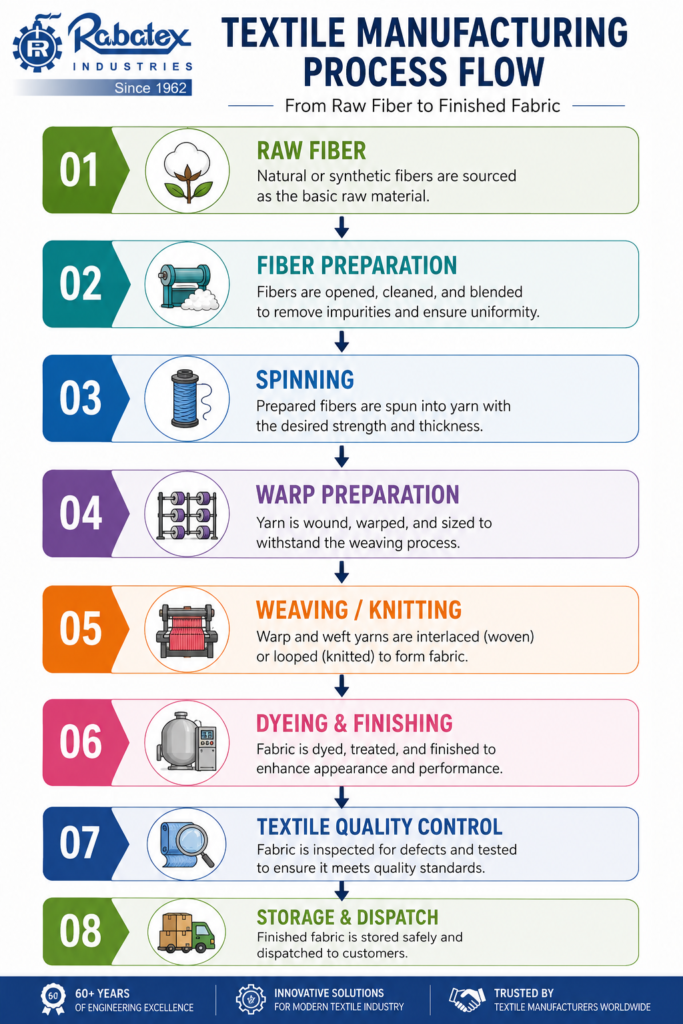
The Textile Manufacturing Process and the Machines Used at Every Stage
Every stage in textile manufacturing has a specific purpose, and each one relies on specialized machinery to keep production moving efficiently. From preparing raw fibers to storing finished fabrics, every machine contributes to the final product’s quality, consistency, and production speed.
Step 1: Fiber Preparation
The manufacturing process begins with preparing raw fibers for spinning. At this stage, fibers are opened, cleaned, and blended to remove impurities and create a uniform mix. Good fiber preparation lays the foundation for producing strong, consistent yarn and helps avoid quality issues later in the process.
Textile machines commonly used:
- Fiber Opening Machines
- Cleaning Machines
- Blending Machines
For example, if cotton fibers contain excess dust or aren’t blended evenly, the spinning process can produce uneven yarn, leading to frequent yarn breaks and inconsistent fabric quality.
Step 2: Spinning
Once the fibers are prepared, they are converted into yarn with the required strength and thickness. The spinning technology used depends on the type of yarn and the fabric being produced. Choosing the right spinning process helps improve yarn uniformity, which directly influences weaving performance and the appearance of the finished fabric.
Textile machines commonly used:
- Ring Spinning Machines
- Rotor Spinning Machines
- Compact Spinning Machines
For instance, denim manufacturers often prefer spinning technologies that produce stronger yarns, while apparel fabric mills may select processes designed to create finer, softer yarn for lightweight fabrics.
Step 3: Yarn Preparation
The yarn produced during spinning isn’t ready for weaving just yet. It first goes through winding, warping, and sizing to ensure it can withstand the tension and friction of the weaving process. Proper yarn preparation helps reduce yarn breakage, improve loom efficiency, and maintain consistent fabric quality.
Textile machines commonly used:
- Warping Machines
- Sectional Warping Machines
- Sample Warping Machines
- Sizing Machines
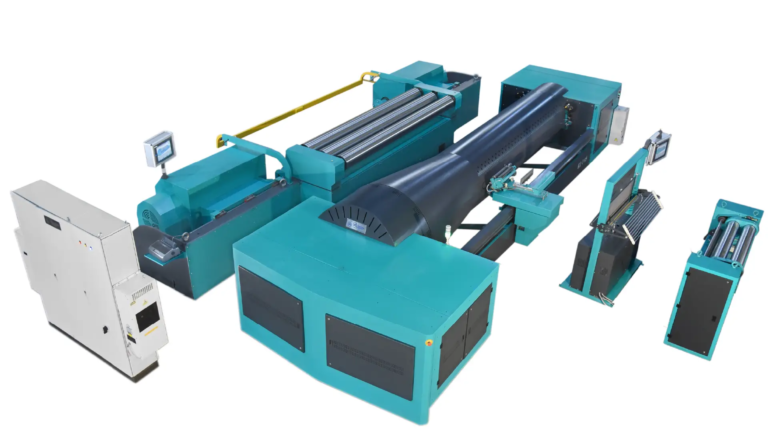
For example, if a home textile manufacturer is developing a new bedsheet collection, a Sample Warping Machine allows the team to prepare trial warps quickly without interrupting the main production line. Once the design is approved, production shifts to a Sectional Warping Machine for commercial manufacturing.
For manufacturers producing heavy fabrics such as denim or industrial textiles, Techtronics Heavy Duty Warping solutions provide the strength and stability needed to prepare warp beams for demanding production environments.
Step 4: Fabric Formation
After the yarn is prepared, it’s converted into fabric through weaving or knitting. The choice of machine depends on the fabric construction, production speed, and end application. At this stage, maintaining consistent yarn tension and machine settings is essential for producing defect-free fabric.
Textile machines commonly used:
- Shuttle Looms
- Rapier Looms
- Air Jet Looms
- Water Jet Looms
- Knitting Machines
For example, air jet looms are widely used for high-speed woven fabric production, while knitting machines are preferred for stretch fabrics used in sportswear, innerwear, and fashion apparel.
Step 5: Dyeing, Finishing, and Textile Quality Control
Once the fabric is formed, it moves to dyeing and finishing, where it receives its color, texture, and functional properties. Before the fabric is packed or dispatched, it also undergoes quality inspection to ensure it meets the required standards.
Textile machines commonly used:
- Dyeing Machines
- Finishing Machines
- Fabric Inspection Machines
- Automated Defect Detection Systems
For example, technical textile manufacturers often have strict quality requirements. Automated inspection systems help identify defects early, reducing the chances of defective fabric reaching the customer.
Step 6: Material Handling and Storage
Production doesn’t end once the fabric is ready. Yarn packages, fabric rolls, samples, and spare parts need to be stored safely and retrieved quickly whenever required. As production volumes increase, manual storage can lead to misplaced inventory and longer retrieval times.
Textile machines commonly used:
- Vertical Lift Modules (VLMs)
- Automated Storage and Retrieval Systems (ASRS)
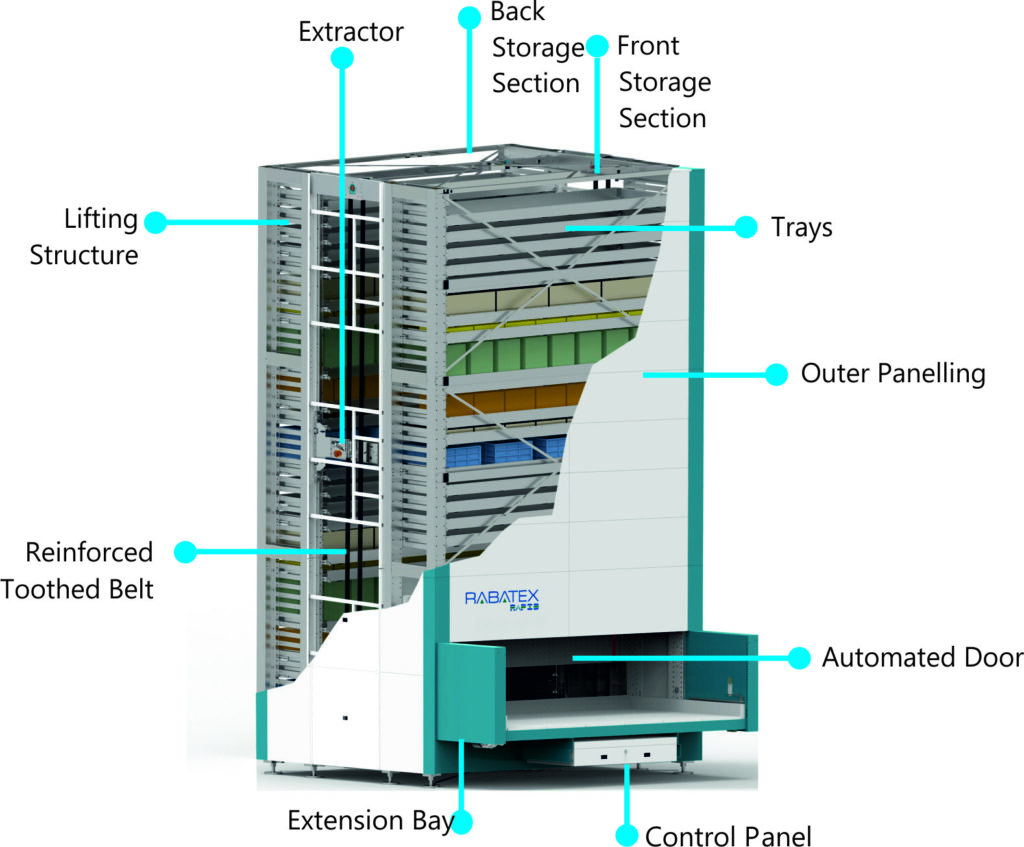
For example, a denim mill handling hundreds of yarn packages every day can use a Vertical Lift Module (VLM) to save floor space, improve inventory accuracy, and retrieve materials within minutes instead of searching through multiple storage racks.
How Textile Machines Work Together in Modern Manufacturing
Buying the right textile machine is important, but it’s only one part of the equation. What really determines production efficiency is how well each machine works with the next stage in the manufacturing process.
Think of it as a relay race. Every machine passes its output to the next one. If one stage falls behind or produces inconsistent results, the impact is carried through the rest of the production line.
For example:
- Poor fiber preparation can result in uneven yarn during spinning.
- Inconsistent warp preparation can increase yarn breakage during weaving.
- Fabric defects that go unnoticed during inspection may lead to customer complaints or product returns.
- Inefficient material storage can delay production simply because operators spend more time locating yarn packages or spare parts.
When every stage is connected efficiently, manufacturers can expect:
- Better production flow with fewer interruptions
- Consistent fabric quality across batches
- Reduced material waste and rework
- Faster production cycles
- Improved machine utilization
This is also why many textile manufacturers prefer working with an experienced textile machine manufacturer that understands the complete production process rather than supplying individual machines. Integrated solutions not only simplify operations but also make it easier to scale production as business requirements grow.
Applications of Textile Machines Across Different Textile Industries
No two textile manufacturers have the same production requirements. A denim mill focuses on strong warp yarns and high-speed weaving, while a technical textile manufacturer prioritizes precision and product performance. That’s why the choice of textile machines often depends on the type of fabric being produced and the scale of manufacturing.
Here’s how different industries use textile machinery to meet their production goals.
Textile Machines for Denim Manufacturing
Denim manufacturing demands strong yarns, high-speed weaving, and consistent fabric quality. Since production runs are typically large, manufacturers look for machines that can maintain accuracy, reduce downtime, and deliver uniform output over long operating hours. Efficient material handling also becomes important as yarn packages, beams, and finished fabrics move continuously across the production floor.
Machines commonly used
- Ring Spinning Machines
- Sectional Warping Machines
- Air Jet or Rapier Looms
- Fabric Inspection Machines
- Vertical Lift Modules (VLMs)
Example:
A denim mill expanding its production capacity may invest in a Sectional Warping Machine to prepare high-quality warp beams with consistent tension. Adding a Vertical Lift Module further improves efficiency by organizing yarn packages and spare parts while reducing retrieval time.
Textile Machines for Home Textile Manufacturing
Home textile manufacturers produce a wide variety of products, including bed linen, curtains, upholstery fabrics, and table linen. Frequent design changes and varying fabric specifications require machinery that offers both flexibility and consistent production quality.
Typical machinery for this application
- Warping Machines
- Sample Warping Machines
- Weaving Machines
- Dyeing and Finishing Machines
- Fabric Inspection Machines
Example:
Before launching a new bedsheet or curtain collection, manufacturers can use a Sample Warping Machine to evaluate different weave structures and yarn combinations. Once finalized, production can move to larger warping systems for commercial manufacturing.
Textile Machines for Terry Towel Manufacturing
Producing terry towels involves creating uniform loops that determine the towel’s softness, absorbency, and appearance. Maintaining consistent yarn preparation and weaving conditions is essential to achieve the desired pile quality throughout production.
Key textile machines:
- Warping Machines
- Terry Weaving Machines
- Dyeing and Finishing Machines
- Fabric Inspection Machines
Example:
A terry towel manufacturer aiming to reduce weaving defects may focus on improving warp preparation before investing in faster weaving equipment, ensuring better loop formation and consistent product quality.
Textile Machines for Technical Textile Manufacturing
Technical textiles are designed for performance-driven applications such as automotive, medical, filtration, protective clothing, and geotextiles. These products often have strict performance and quality requirements, making precision manufacturing and quality inspection a priority.
Recommended textile machinery
- Precision Spinning Machines
- Sectional Warping Machines
- Specialized Weaving Machines
- Automated Inspection Systems
Example:
Manufacturers producing filtration fabrics often invest in automated inspection systems to identify defects early, helping maintain the performance standards expected in industrial applications.
For geotextile production, dedicated Creels for GEO Textile help deliver uniform yarn feeding, supporting consistent fabric quality across long production runs.
Textile Machines for Industrial Fabric Manufacturing
Industrial fabrics are used in demanding applications such as conveyor belts, coated fabrics, tarpaulins, and geotextiles. These products require durable materials, reliable weaving performance, and efficient handling of large fabric rolls throughout production.
Production equipment used
- Heavy-duty Weaving Machines
- Coating and Finishing Machines
- Fabric Inspection Machines
- Automated Storage Systems
Example:
An industrial fabric manufacturer handling bulky rolls can improve warehouse efficiency by introducing automated storage systems, making it easier to organize inventory and retrieve materials without disrupting production.
Manufacturers processing synthetic yarns often rely on Poly Beamers & Unrolling Creels to ensure smooth beam handling and controlled yarn unwinding throughout production.
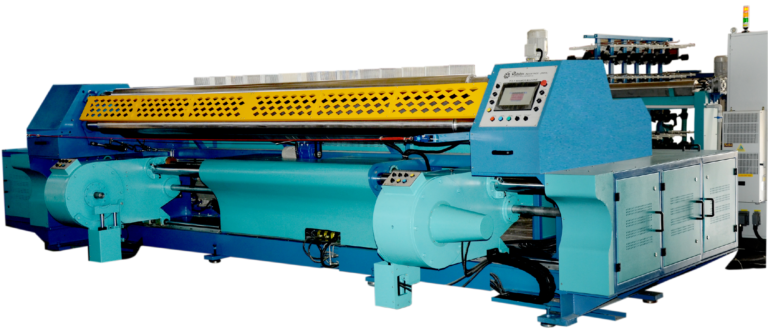
Textile Machines for Apparel Fabric Mills
Apparel manufacturers work in a fast-moving market where new fabric developments and shorter lead times have become the norm. Sampling, quick design validation, and efficient production planning are essential to bring new collections to market faster.
Machines typically found in these facilities
- Sample Warping Machines
- Sample Weaving Machines
- Warping Machines
- Dyeing Machines
- Fabric Inspection Machines
Example:
Instead of preparing a full production warp for every new design, apparel fabric mills can use a Sample Warping Machine and Sample Weaving Machine to produce trial fabrics quickly. This helps designers evaluate fabrics, make changes faster, and reduce yarn consumption during product development.
When manufacturing fabrics with monofilament yarns, specialized Mono Filament Creels help maintain controlled yarn tension and smooth feeding during warp preparation.
Common Manufacturing Challenges and How Modern Textile Machines Solve Them
Textile manufacturers today are under constant pressure to produce more in less time while maintaining consistent quality and controlling costs. Whether it’s a denim mill handling large production volumes or an apparel fabric manufacturer developing new collections, the challenges are often similar. Modern textile machines and automation are helping manufacturers overcome these issues and build more efficient production systems.
Labour Shortages and Dependence on Manual Processes
Finding skilled operators has become increasingly difficult, especially for repetitive and labor-intensive tasks. Relying heavily on manual processes can also lead to inconsistent production and slower operations.
Modern textile machines automate many routine activities, reducing manual intervention while improving process consistency. Automated material handling and quality inspection further help manufacturers optimize their workforce.
Material Waste and Production Losses
Yarn breakage, weaving defects, and repeated sampling can lead to unnecessary material waste and increased production costs. Even small inefficiencies become significant in high-volume manufacturing.
Modern textile machinery improves process accuracy, helping manufacturers reduce yarn waste, minimize rework, and make better use of raw materials throughout the production cycle.
Maintaining Consistent Product Quality
Customers expect every production batch to meet the same quality standards. Variations in yarn preparation, weaving, dyeing, or finishing can result in rejected orders and customer complaints.
Advanced textile machines support better process control, while automated inspection systems help identify defects before the fabric reaches dispatch.
Rising Production Costs
Increasing labor costs, energy prices, and raw material expenses continue to put pressure on textile manufacturers. Improving operational efficiency has become just as important as increasing production capacity.
Machines with higher productivity, better resource utilization, and automation capabilities help manufacturers lower operating costs and improve long-term returns on investment.
Limited Warehouse Space and Material Handling
As production grows, so does the need to store yarn packages, fabric rolls, samples, and spare parts. Traditional storage methods often occupy valuable floor space and make material retrieval time-consuming.
Warehouse automation solutions such as Vertical Lift Modules (VLMs) and Automated Storage and Retrieval Systems (ASRS) help maximize storage capacity, improve inventory accuracy, and reduce the time spent locating materials.
Traditional vs Automated Textile Manufacturing
As textile manufacturing evolves, automation is becoming a key driver of productivity, quality, and operational efficiency. The comparison below highlights how modern textile machinery improves upon traditional manufacturing methods.
The Role of Textile Machines in Modern Manufacturing
Modern textile machines do much more than automate individual production tasks. They help manufacturers build connected, efficient, and scalable production environments that can adapt to changing customer demands and market conditions.
Improving Productivity and Textile Quality
Consistent production starts with consistent processes. Modern textile machinery helps manufacturers maintain accuracy across every stage, reducing production interruptions and ensuring uniform fabric quality.
Some of the key benefits include:
- Higher production output with fewer stoppages
- Consistent yarn and fabric quality across batches
- Reduced defects and rework
- Better machine utilization and production efficiency
Enabling Textile Automation and Industry 4.0
Automation is no longer limited to individual machines. Today’s textile manufacturers are adopting connected production systems that provide better visibility and control over the entire manufacturing process.
Modern textile machinery can support:
- Machine connectivity across production lines
- Real-time production monitoring
- Production analytics for better decision-making
- Predictive maintenance to reduce unexpected downtime
- Integration with smart factory initiatives
These capabilities allow manufacturers to identify production bottlenecks early and make informed operational decisions.
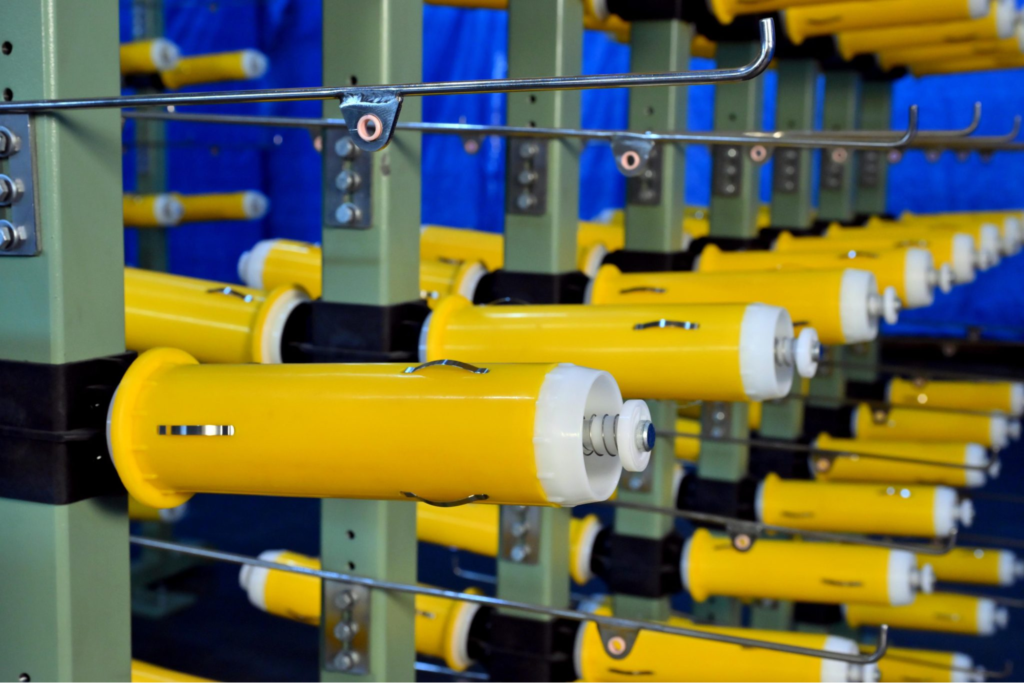
As manufacturers move into advanced applications such as aerospace, automotive, and high-performance composites, specialized equipment like Carbon Fiber Creels supports precise yarn handling, helping maintain the consistency these materials demand.
Reducing Waste and Operating Costs
Reducing waste isn’t just about saving raw materials. It also means making better use of time, energy, and available resources.
Modern textile machines help manufacturers:
- Optimize yarn and fabric utilization
- Reduce production errors and rework
- Improve energy efficiency
- Lower overall manufacturing costs
Over time, these improvements contribute to better profitability and a stronger return on investment.
Supporting Smarter Material Handling and Inventory Management
As manufacturing volumes increase, managing materials efficiently becomes just as important as producing them. Organized storage and quick access to inventory help keep production running without unnecessary delays.
Warehouse automation solutions such as Vertical Lift Modules (VLMs) and Automated Storage and Retrieval Systems (ASRS) enable manufacturers to:
- Maximize available warehouse space
- Improve inventory accuracy
- Retrieve materials faster
- Reduce manual material handling
- Support uninterrupted production workflows
For manufacturers looking to modernize their operations, investing in textile machines is no longer just about increasing capacity. It’s about building a smarter, more connected manufacturing process that delivers consistent quality, higher productivity, and long-term operational efficiency.
How to Choose the Right Textile Machinery and Manufacturer
Investing in textile machinery is a long-term decision. The right machine can improve productivity and product quality for years, while the wrong one can lead to frequent downtime, higher maintenance costs, and production bottlenecks. Before making an investment, it’s worth looking beyond the machine’s specifications and evaluating how well it fits your manufacturing requirements.
Understand Your Production Requirements
Start by looking at what you manufacture today and where your business is headed. The machinery you choose should match your product range, production volume, and manufacturing process.
For example, if you’re producing new fabric designs regularly, investing in sampling equipment can speed up product development. On the other hand, high-volume production may require machines designed for continuous operation and higher throughput.
Your choice should also consider the type of yarn you work with. For example, manufacturers processing glass fiber yarns require specialized equipment such as Glass Fiber Creels to ensure smooth yarn feeding and maintain consistent tension during production.
Evaluate Automation Capabilities
Automation isn’t about replacing people. It’s about making production more efficient and reducing repetitive manual tasks.
Look for machinery that offers features such as:
- Automated process control
- Real-time production monitoring
- Easy integration with existing production lines
- Data collection for performance tracking
These capabilities can help you improve productivity while maintaining consistent quality.
Choose Machinery That Can Grow with Your Business
Your production requirements today may not be the same two or three years from now. Selecting machinery that can support higher production volumes or future upgrades can save you from expensive replacements later.
Scalable solutions also make it easier to introduce new products without completely redesigning your production line.
Consider Service and Spare Parts Support
Even the best textile machine requires regular maintenance. Before choosing a supplier, check how quickly spare parts are available and what kind of technical support they provide.
Reliable after-sales service helps minimize downtime and keeps your production running smoothly when unexpected issues arise.
Look for Engineering Expertise, Not Just Equipment
A machine supplier should understand your manufacturing process, not simply recommend a product from a catalogue. An experienced textile machine manufacturer like Rabatex can help you identify the right solution based on your production goals, factory layout, and future expansion plans.
The right partner will also support installation, commissioning, operator training, and long-term maintenance, helping you get the most value from your investment.
Ultimately, choosing textile machinery isn’t just about buying equipment. It’s about investing in solutions that improve efficiency today while preparing your manufacturing facility for future growth.
Build a Future-Ready Textile Manufacturing Facility with Rabatex
The right textile machines do more than automate individual processes. They help you build a manufacturing setup that delivers consistent quality, improves productivity, and adapts to changing business needs. From fiber preparation and warp preparation to sampling and warehouse management, every investment contributes to a more efficient production line.
At Rabatex, we understand that every textile manufacturer has unique production requirements. That’s why we offer a comprehensive range of textile machinery designed to support different stages of the textile manufacturing process, including:
- Sectional Warping Machines for accurate and efficient warp preparation
- Sectional Warping Machines for faster fabric development and sampling
- Sample Weaving Machines for producing high-quality fabric samples
- Vertical Lift Modules (VLMs) for automated storage and efficient material handling
Backed by more than 60 years of engineering expertise, Rabatex combines innovation, reliable technology, and dedicated customer support to help textile manufacturers improve efficiency and prepare for future growth.
Not sure which textile machines are right for your manufacturing process? Our team can help you identify the right solutions based on your products, production capacity, and long-term expansion plans. Contact us today!
Take the Next Step Toward Smarter Textile Manufacturing
The right combination of textile machines can help you reduce waste, improve quality, and increase production efficiency. Explore Rabatex’s innovative solutions for warp preparation, fabric sampling, and warehouse automation, and build a manufacturing process that’s ready for the future.
-
What are textile machines?
Textile machines are specialized equipment used at different stages of the textile manufacturing process, from fiber preparation and spinning to weaving, dyeing, finishing, quality inspection, and material storage. Each machine performs a specific task to improve production efficiency, maintain product quality, and reduce manual effort.
-
What is the textile manufacturing process?
The textile manufacturing process is the journey of converting raw fibers into finished fabrics. It typically includes fiber preparation, spinning, warp preparation, weaving or knitting, dyeing and finishing, textile quality control, and storage before dispatch. Each stage relies on dedicated textile machinery to ensure smooth and consistent production.
-
Which textile machines are essential for textile manufacturing?
The machines required depend on the type of textile being produced, but some of the most commonly used textile machines include:
Fiber preparation machines
Ring, Rotor, or Compact Spinning Machines
Warping and Sectional Warping Machines
Sample Warping Machines
Weaving or Knitting Machines
Dyeing and Finishing Machines
Fabric Inspection Machines
Vertical Lift Modules (VLMs) and Automated Storage Systems
The right combination of machinery varies based on your production process and business requirements. -
What is the difference between textile machines and textile machinery?
The terms are often used interchangeably, but there’s a slight difference. A textile machine refers to a single piece of equipment, such as a warping machine or weaving machine. Textile machinery is a broader term that refers to the complete collection of machines used throughout the textile manufacturing process.
-
How does textile automation improve production?
Textile automation reduces manual intervention by automating repetitive tasks and improving process control. It helps manufacturers:
Increase production efficiency
Maintain consistent product quality
Reduce material waste
Improve machine utilization
Monitor production in real time
Lower operating costs over time
Automation also supports faster decision-making through production data and machine monitoring. -
What is the role of warehouse automation in textile manufacturing?
Warehouse automation helps manufacturers organize, store, and retrieve yarn packages, fabric rolls, samples, and spare parts more efficiently. Solutions such as Vertical Lift Modules (VLMs) and Automated Storage and Retrieval Systems (ASRS) maximize storage space, improve inventory accuracy, and reduce the time spent searching for materials, allowing production to continue without unnecessary delays.
-
How do I choose the right textile machine manufacturer?
Look for a manufacturer with proven industry experience, reliable engineering capabilities, strong after-sales support, and readily available spare parts. It’s also important to choose a partner who understands your production process and can recommend solutions based on your manufacturing goals rather than simply supplying equipment.
-
Which textile machines are suitable for a new textile mill?
The answer depends on the products you plan to manufacture. Most new textile mills require machinery for fiber preparation, spinning, yarn preparation, weaving or knitting, dyeing and finishing, quality inspection, and material handling. Working with an experienced textile machine manufacturer like Rabatex can help you identify the right combination of machines based on your production capacity, budget, and future expansion plans.