A common challenge in textile manufacturing is this: the sample gets approved, production begins, and everything looks on track until the first bulk lot reveals unexpected issues. It could be a slight GSM variation, a change in shade after finishing, or a fabric hand feel that doesn’t quite match the approved sample. By then, you’re dealing with rework, delays, and additional costs instead of a smooth production run.
This is exactly why fabric sampling is much more than a customer approval step. It helps you validate whether the fabric can be produced consistently before you invest in bulk manufacturing. Identifying a problem during sampling is far easier and less expensive than correcting it after production has already started.
This concern is echoed by textile professionals as well. In a Reddit discussion, manufacturers shared that the biggest challenge isn’t getting a sample approved, but ensuring the same quality can be consistently replicated during commercial production.

Whether you manufacture denim, home textiles, technical textiles, terry towels, industrial fabrics, or apparel fabrics, a structured sampling process helps reduce production risks and build confidence before commercial production begins. In this article, you’ll learn why fabric sampling is essential, how it supports Fabric Quality Testing and Textile Quality Assurance, and how a well-planned fabric development process can help you move from development to commercial production with greater confidence. The right sampling solutions can also help you make this process more consistent and efficient, particularly when developing new fabrics or customer-specific constructions.
Why Fabric Sampling Is Essential Before Commercial Textile Production
Before investing in bulk production, you need to be confident that your fabric can deliver the same quality at scale. Here’s why fabric sampling plays such a critical role in reducing risks and ensuring consistent production.
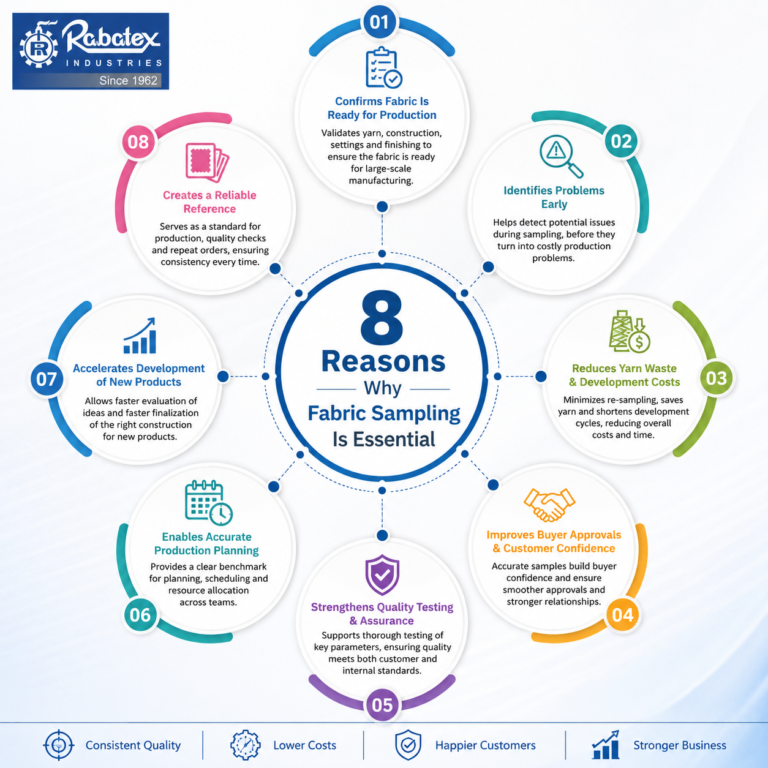
It Helps You Assess Whether the Fabric Is Ready for Commercial Production
Getting a fabric sample approved is an important milestone, but it doesn’t automatically mean the fabric will perform exactly the same way in commercial production. Before moving to bulk manufacturing, you need to assess whether the selected yarn, construction, settings, and finishing approach can be reproduced consistently at a larger scale.
A fabric can perform well during development but behave differently once commercial production begins. It could be a change in GSM after finishing, unexpected shrinkage, or a fabric construction that becomes less consistent during longer production runs. Sampling gives your team an opportunity to identify and evaluate these factors before committing significant yarn, machine time, and production capacity.
Before moving toward bulk production, use the sample to evaluate:
- Yarn suitability for production
- Weave construction and fabric appearance
- Warp and weft settings
- GSM and width consistency
- Finishing performance
- Repeatability across sample runs
For example, if you’re developing a premium denim fabric with stretch properties, the sample may achieve the desired appearance but show lower recovery after finishing. Identifying this during sampling gives your R&D and production teams an opportunity to review the construction or finishing approach before commercial production begins.
The purpose of sampling isn’t to guarantee that every production variable will behave exactly as expected. It is to validate what you can, identify potential risks early, and build greater confidence before scaling up.
It Helps Identify Problems Before They Become Costly
No mill wants to discover a quality issue after the production beam is already on the loom. By then, you’ve already invested in yarn, machine time, manpower, and production planning. Even a small correction can delay deliveries, increase production costs, and create unnecessary pressure on your team.
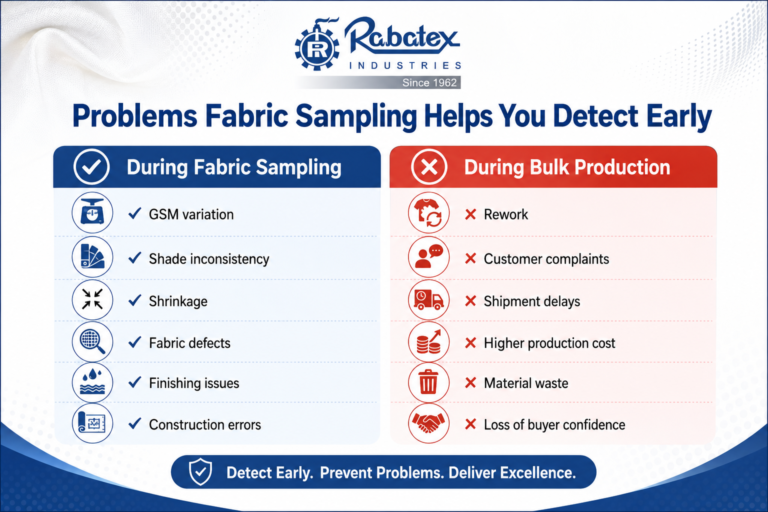
Fabric sampling gives you the opportunity to catch these issues while they’re still manageable. Instead of reacting to problems during production, you can identify them early, understand what’s causing them, and make improvements before they affect an entire production batch. During the sampling stage, your team can identify issues such as:
- GSM variation
- Uneven fabric construction
- Shade inconsistency
- Excessive shrinkage
- Poor finishing performance
- Surface defects or weaving faults
Let’s say you’re developing a new terry towel for a hospitality customer. The sample may reveal that the selected yarn isn’t delivering the required absorbency after finishing. At this stage, changing the yarn count or modifying the finishing recipe is relatively simple. If the same issue appears after thousands of towels have already been produced, you’re no longer solving a technical problem. You’re dealing with rework, delayed dispatches, and a dissatisfied customer. The earlier you identify a problem, the easier it is to fix and the less it costs your business.
It Reduces Yarn Waste and Development Costs
If your development team has to prepare three or four samples before arriving at the right construction, the actual cost goes well beyond the yarn used in those trials. Every additional sample occupies machines, operators, quality inspectors, and valuable development time that could have been spent on the next project.
A well-planned sampling process, supported by the right fabric development sample warping machine, helps you get closer to the final fabric much earlier. Instead of correcting one issue after another, your team can validate the fabric’s construction, performance, and manufacturability together before moving ahead with production.
Every extra redevelopment cycle usually means:
- More yarn consumption
- Additional warping and weaving time
- Repeated quality inspections
- Delayed customer approvals
- Higher development costs
This becomes even more important if you’re supplying fabrics to multiple apparel brands or regularly developing customized products. Shorter development cycles allow you to take on more projects without increasing pressure on your production floor.
In the long run, efficient sampling isn’t just about saving yarn. It helps improve machine utilization, reduces unnecessary development work, and allows your team to move into commercial production much faster.
It Improves Buyer Approvals and Customer Confidence
Getting a buyer to approve a fabric isn’t only about presenting a sample that looks good. They’re also evaluating whether your mill can reproduce that same quality consistently when bulk production begins.
If you’ve worked with apparel brands, home textile exporters, or international buyers, you’ll know that they closely compare production fabric with the approved sample. Even small differences in shade, GSM, texture, or hand feel can lead to additional inspections, fresh sample requests, or production delays.
A strong sampling process gives buyers confidence because it demonstrates that the fabric has already been tested and validated before production starts.
A good sample helps buyers verify:
- Fabric appearance and weave construction
- GSM and width specifications
- Shade consistency
- Hand feel and finish
- Overall quality and performance
For example, a home textile manufacturer supplying premium bed linen to an overseas retailer cannot afford noticeable differences between the approved sample and the final shipment. Consistency is often just as important as quality itself because repeat orders depend on it.
When your sample accurately reflects what you’ll deliver in production, approvals become smoother, customer queries reduce, and your reputation as a reliable manufacturing partner becomes even stronger.
It Strengthens Fabric Quality Testing and Textile Quality Assurance
If quality checks begin only after bulk production, you’re already working against the clock. By that stage, the fabric has been woven, processed, and a considerable amount of yarn, machine time, and manpower has already been invested. Discovering a problem then often means deciding whether to rework the fabric or accept the loss.
That’s why Fabric Quality Testing should begin during the sampling stage, not after production.
A well-prepared sample gives your quality team enough time to verify whether the fabric meets both customer expectations and your internal quality standards before it reaches the production floor.
During fabric sampling, it’s worth validating:
- GSM and fabric width
- Shrinkage after washing or finishing
- Color fastness
- Tensile and tear strength
- Dimensional stability
- Fabric appearance and hand feel
Imagine you’re manufacturing industrial fabrics for filtration or automotive applications. Even a small variation in tensile strength or dimensional stability can affect the product’s performance. Discovering that during sampling gives your team the opportunity to fine-tune the construction before production starts. Discovering it after dispatch could mean customer complaints, product returns, and damage to your reputation.
A strong sampling process doesn’t replace Textile Quality Assurance. It strengthens it by ensuring quality is built into the fabric from the beginning rather than inspected after the fact.
It Makes Production Planning More Accurate
Planning commercial production becomes much easier when everyone is working from a validated sample instead of assumptions.
Once the sample has been approved, your production team has a practical reference for key production considerations.
Machine settings, yarn requirements, finishing expectations, and quality parameters can be reviewed against the validated sample before commercial production begins. This helps teams plan resources and prepare for production with greater confidence.
An approved sample also helps different departments stay on the same page.
It gives clarity to:
- Production teams preparing machine settings
- Planning teams scheduling machine capacity
- Procurement teams arranging yarn requirements
- Quality teams defining inspection standards
- Merchandising teams communicating with customers
For example, if you’re producing home textiles for a large retail chain, delivery schedules are often planned months in advance. The last thing you want is production stopping because the fabric behaves differently than expected. A properly validated sample helps your planning team allocate resources with confidence, reducing last-minute changes that affect both production and delivery timelines.
Good production planning isn’t just about meeting deadlines. It’s about ensuring every department starts with the same understanding of what the finished fabric should look and perform like.
It Accelerates Fabric Development for New Products
Whether you’re launching a new denim collection, developing sustainable fabrics, or creating customer-specific constructions, speed matters. Buyers expect quicker approvals, shorter lead times, and faster product development than ever before.
But moving faster shouldn’t mean taking shortcuts.
A structured sampling process actually helps you accelerate development because it allows your team to evaluate multiple possibilities before committing to production. Instead of making adjustments after weaving begins, you can compare different yarn combinations, weave designs, and finishing treatments while the fabric is still in development.
This gives your R&D team the flexibility to answer questions like:
- Which yarn performs better?
- Does this weave deliver the required appearance?
- How does the fabric behave after finishing?
- Can this construction be reproduced consistently?
- Is the fabric commercially viable?
Suppose you’re developing a new apparel fabric for a customer introducing a seasonal collection. Approval timelines are already tight, and delaying fabric development could affect garment production as well. An efficient sampling process helps you finalize the right construction sooner, allowing you to move into production without compromising quality.
The faster you validate your fabric, the faster you can respond to customer requirements and market opportunities.
It Creates a Reliable Reference for Every Team
A fabric sample doesn’t lose its importance once the customer signs off on it. In fact, that’s when it becomes one of the most valuable references in your mill.
Throughout commercial production, teams can refer back to the approved sample as a practical benchmark for checking whether the fabric being manufactured aligns with what was originally approved. Instead of relying only on technical specifications, your teams have a physical benchmark that everyone understands.
An approved sample becomes the reference for:
- Production during weaving
- Quality inspections
- Customer discussions
- Repeat order development
- Future fabric innovations
Let’s say your denim mill receives a repeat order six months after the original shipment. Technical specifications may tell you the yarn count and weave pattern, but the approved sample reminds your team exactly how the fabric should look, feel, and perform. That makes it much easier to reproduce the same quality and meet customer expectations without unnecessary trial runs.
This consistency is what builds long-term customer relationships. When every department works from the same approved reference, communication improves, production becomes more predictable, and customers know they can expect the same quality every time they place an order.
Where Fabric Sampling Fits in the Fabric Development Process
A common misconception is that fabric sampling is simply another step between yarn selection and production. In reality, it’s often the stage where you assess whether the fabric is ready to move forward or needs further refinement.
The exact development workflow can vary depending on the fabric type, manufacturing process, and customer requirements. Decisions made before sampling, from yarn selection to warp preparation, can influence how the fabric will perform, while sampling results help guide the next steps. That’s why experienced textile manufacturers use sampling as a checkpoint before committing valuable resources to commercial production.
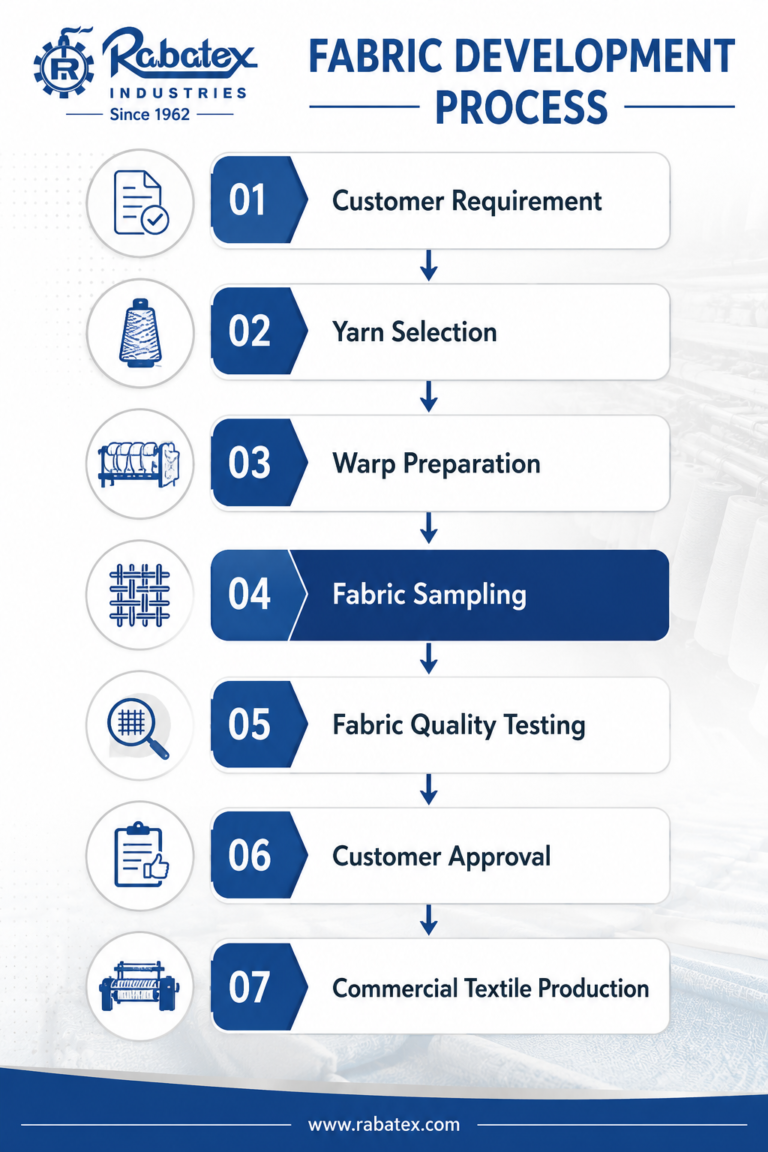
Let’s look at how each stage contributes to a successful production run.
Customer Requirement
Every fabric development project begins with understanding what the customer actually needs. It isn’t just about the fabric design. You also need clarity on technical specifications, end use, performance expectations, quality standards, and delivery timelines.
The clearer these requirements are at the beginning, the fewer changes you’ll need during development.
Yarn Selection
Once the requirements are finalized, selecting the right yarn becomes the next priority. Yarn count, fiber composition, strength, twist, and quality all influence how the finished fabric will look and perform.
Choosing the wrong yarn at this stage can affect everything that follows, from weaving performance to finishing results.
Warp Preparation
Even the best yarn won’t deliver consistent results if the warp isn’t prepared correctly.
Uneven yarn tension, improper beam formation, or inconsistent warp preparation can influence fabric construction and create variations during sampling. That’s why this stage deserves as much attention as weaving itself.
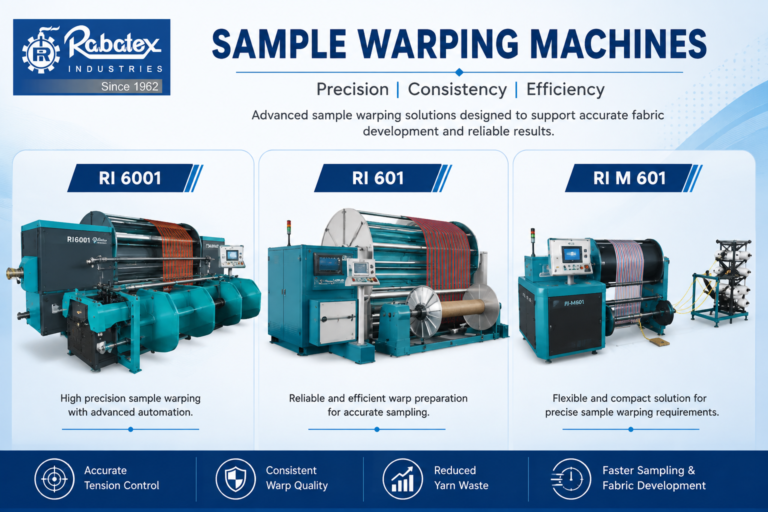
For manufacturers developing multiple fabric samples, dedicated equipment such as the Rabatex RI 6001, RI 601, and RI M 601 can support sample warp preparation.
Fabric Sampling
This is the stage where you bring your development decisions together and evaluate how the fabric performs before moving into bulk production.
Fabric sampling helps you assess whether the selected yarn, weave construction, warp preparation, and finishing process are working together as intended. Rather than assuming the fabric is ready for production, you can evaluate it using the selected yarn, fabric construction, and relevant process parameters before committing to commercial manufacturing.
During this stage, your team can assess whether the fabric meets the required customer specifications and identify areas that may need adjustment before moving forward. This gives you a more reliable basis for production planning and helps build confidence in the fabric’s repeatability at commercial scale.
Fabric Quality Testing
Once the sample is ready, it’s time to validate its performance.
Your quality team evaluates whether the sample meets both customer expectations and internal quality standards through Fabric Quality Testing.
Typical evaluations include:
- GSM
- Fabric width
- Shrinkage
- Color fastness
- Fabric appearance
- Hand feel
- Strength and
- dimensional stability
If any parameter falls outside the required specification, it’s much easier to make corrections now than after commercial production begins.
Customer Approval
With testing complete, the approved sample is shared with the customer for evaluation.
This approval is about much more than appearance. It confirms that both you and your customer agree on what the final fabric should look, feel, and perform like before production starts.
That approved sample then becomes the reference for every production batch.
Commercial Textile Production
Only after every previous stage has been successfully completed should commercial production begin.
At this point, your team isn’t relying on assumptions or trial runs. You’re producing a fabric that has already been developed, tested, approved, and validated.
That’s exactly why fabric sampling sits at the heart of the fabric development process. It connects product development with commercial manufacturing and gives you the confidence to move into production knowing the fabric is ready for scale.
What Should Be Evaluated During Fabric Sampling?
A sample should do more than look good. Before you approve it for commercial production, you need to be confident that it meets your technical requirements, customer expectations, and production standards.
The checklist below covers the key parameters every textile manufacturer should evaluate during fabric sampling.
Rather than evaluating these parameters in isolation, involve your production, R&D, and quality teams during the review. A fabric is truly ready for commercial production only when it satisfies both technical specifications and practical manufacturing requirements.
Why Accurate Warp Preparation Matters During Fabric Sampling
A fabric sample is only as reliable as the warp beam used to create it. If the warp preparation isn’t accurate, the sample may not truly reflect how the fabric will perform during commercial production.
Issues such as uneven yarn tension, inconsistent beam formation, or yarn breakage can affect the sample long before weaving begins. This may lead to repeated sampling, unnecessary yarn consumption, and development delays.
Common warp preparation challenges include:
- Uneven yarn tension
- Inconsistent warp beam formation
- Yarn breakage during warping
- Difficulty reproducing the same sample
- Higher yarn waste during development
This is why many textile manufacturers use dedicated sampling solutions such as the Rabatex RI 6001, RI 601, and RI M 601 for fabric development. These machines support warp preparation for fabric sampling and help manufacturers evaluate their fabric development.
They enable mills to produce consistent warp beams for sampling, helping reduce yarn waste, shorten development time, and improve repeatability before moving into commercial production.
When your warp preparation is accurate, your fabric sample becomes a dependable reference for quality testing, customer approvals, and production planning.
From Better Fabric Sampling to Better Commercial Production
The quality of your commercial production is closely linked to the decisions made during fabric sampling. When the sample is developed with accurate warp preparation and carefully evaluated, you have a better basis for refining the fabric before it moves into commercial production. This can help your teams make decisions with greater confidence and reduce the risk of unexpected issues later in the process.
A consistent sampling process also gives your R&D, production, and quality teams a common reference when reviewing and refining a fabric. The goal is not simply to produce a sample, but to develop a fabric that is ready to move forward with greater clarity and confidence.
The right equipment can support this process from the warp preparation stage. Rabatex offers Sample Warping Machines, including the RI 6001, RI 601, and RI M 601, for fabric sampling and development, subject to verification of the specific product specifications and claims before publication.
If you are looking to make your fabric sampling process more accurate and efficient, explore Rabatex’s Sample Warping Machine solutions for your fabric development requirements. Contact us to discuss your sampling needs.