
Walk into almost any textile manufacturing facility, and you’ll notice one common challenge. There never seems to be enough storage space.
Yarn packages, fabric rolls, spare parts, tools, dyes, and samples all compete for valuable floor space. As your inventory grows, finding the right material quickly becomes more difficult, slowing down operations and affecting productivity.
If this sounds familiar, you’re not alone. According to the 2023 MHI Annual Industry Report, 74% of supply chain leaders plan to increase investments in supply chain technology and innovation to improve efficiency, resilience, and visibility across their operations. This reflects a growing shift toward smarter storage and automation solutions in manufacturing and warehousing.
One solution that is gaining popularity is the Vertical Lift Module (VLM). Instead of adding more shelving or expanding your warehouse, a VLM makes better use of your existing vertical space by automatically storing and retrieving inventory. Beyond solving storage challenges, manufacturers are increasingly adopting Vertical Lift Modules to improve productivity, optimize inventory, and build warehouses that can scale with future business growth.
As manufacturers continue adopting automation to improve operational efficiency, storage is no longer viewed as just a warehouse function. It has become an important part of improving production continuity, inventory visibility, and overall business performance.
In this guide, you’ll learn what a Vertical Lift Module is, how it works, its key components, and how it can help improve storage efficiency in textile manufacturing and warehouse operations.
What Is a Vertical Lift Module?
A Vertical Lift Module (VLM) is an automated storage system that stores materials in vertically arranged trays and automatically retrieves them when an operator requests an item.
Unlike traditional shelving, where employees walk through aisles searching for products, a VLM brings the required tray directly to the operator. This is known as the goods-to-person principle.
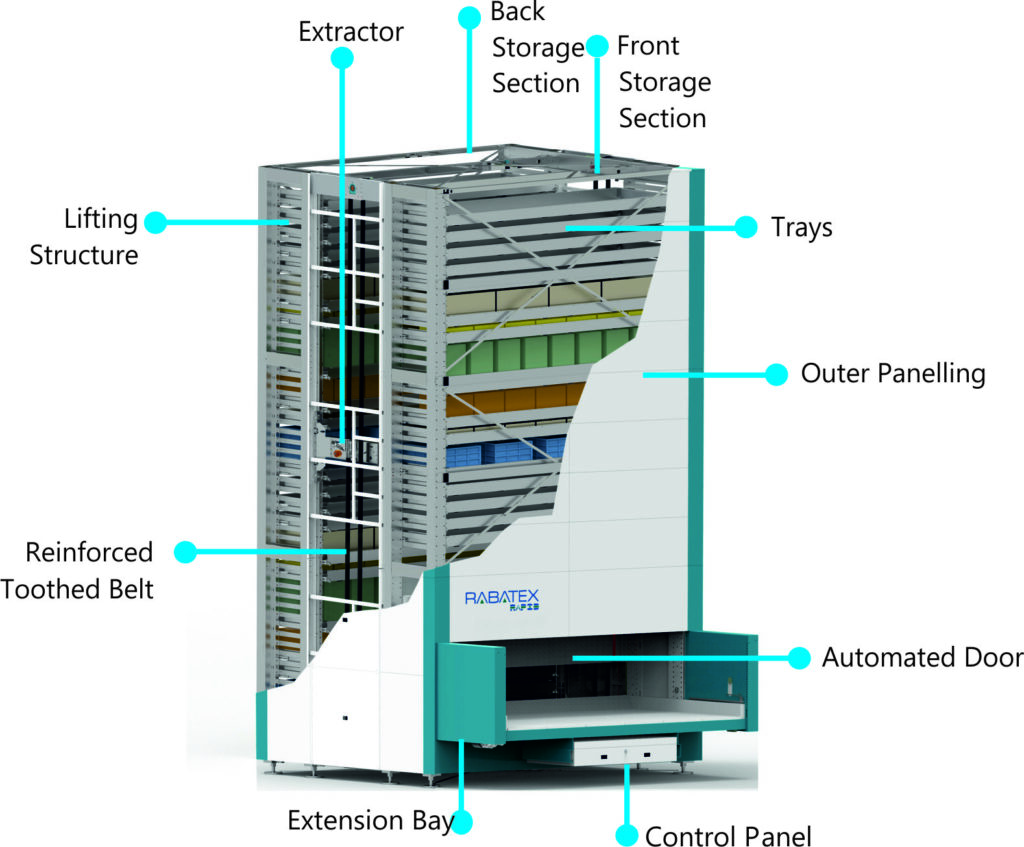
You can call it a giant automated cabinet. Products are stored in enclosed trays stacked vertically, and an internal extractor retrieves the required tray and delivers it to an ergonomic access opening. Once the task is complete, the tray automatically returns to its storage location.
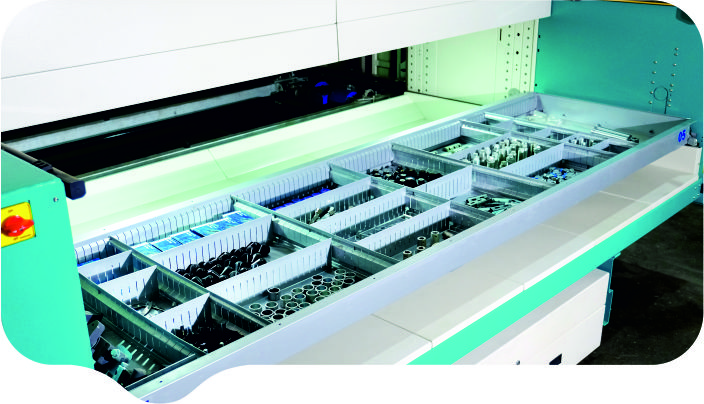
For example, if your maintenance team needs a spare part for a loom, they can simply select it on the control panel, and the system delivers the correct tray within seconds. The same process works for storing yarn cones, weaving accessories, fabric samples, machine tools, and other production materials.
A Vertical Lift Module is a type of Automated Storage and Retrieval System (ASRS) that automates storage and retrieval while reducing manual handling. Because it utilizes vertical space efficiently, it is also considered a Vertical Storage System, helping manufacturers increase storage capacity without expanding their warehouse footprint.
How Does a Vertical Lift Module Work?
Although a Vertical Lift Module uses advanced automation, its working process is surprisingly straightforward.
Let’s look at each step.
Step 1 – Storage of Items
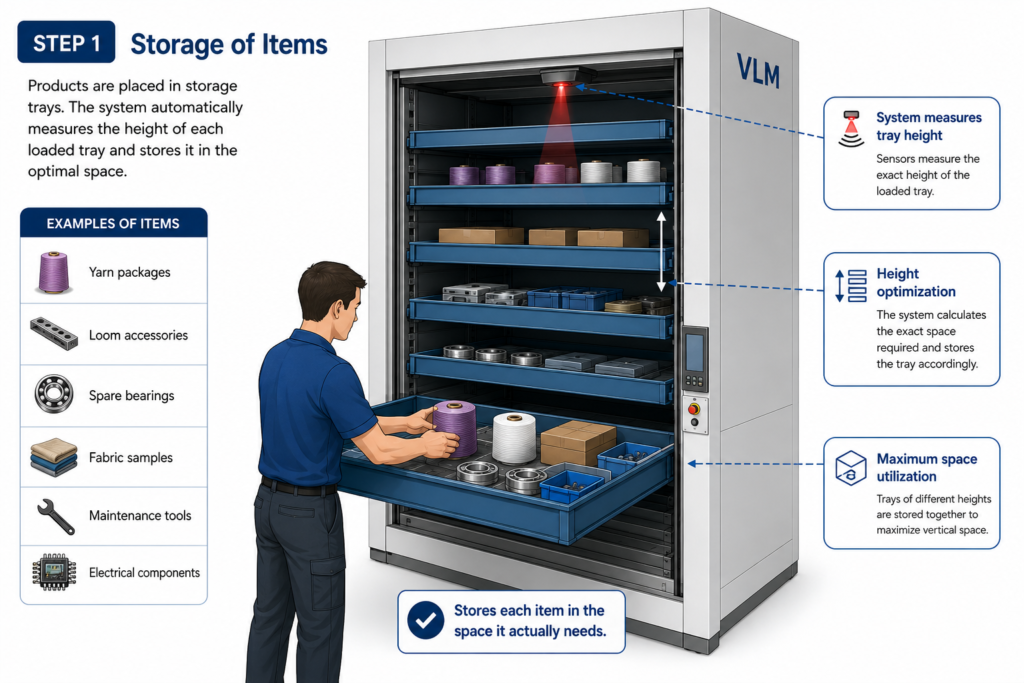
The process begins by placing products inside specially designed storage trays.
These trays are available in different sizes and load capacities depending on the type of inventory you store.
For instance, a textile manufacturer might dedicate different trays for:
- Yarn packages
- Loom accessories
- Spare bearings
- Fabric samples
- Maintenance tools
- Electrical components
The system automatically measures the height of every loaded tray.
Instead of assigning fixed shelf heights, it calculates exactly how much vertical space each tray requires. This intelligent height optimization reduces wasted space and allows more trays to fit inside the machine.
Imagine storing both a small sensor and a large gearbox.
Traditional shelving wastes space because every shelf has the same height. A Vertical Lift Module stores each item only in the space it actually needs.
Step 2 – Inventory Recording
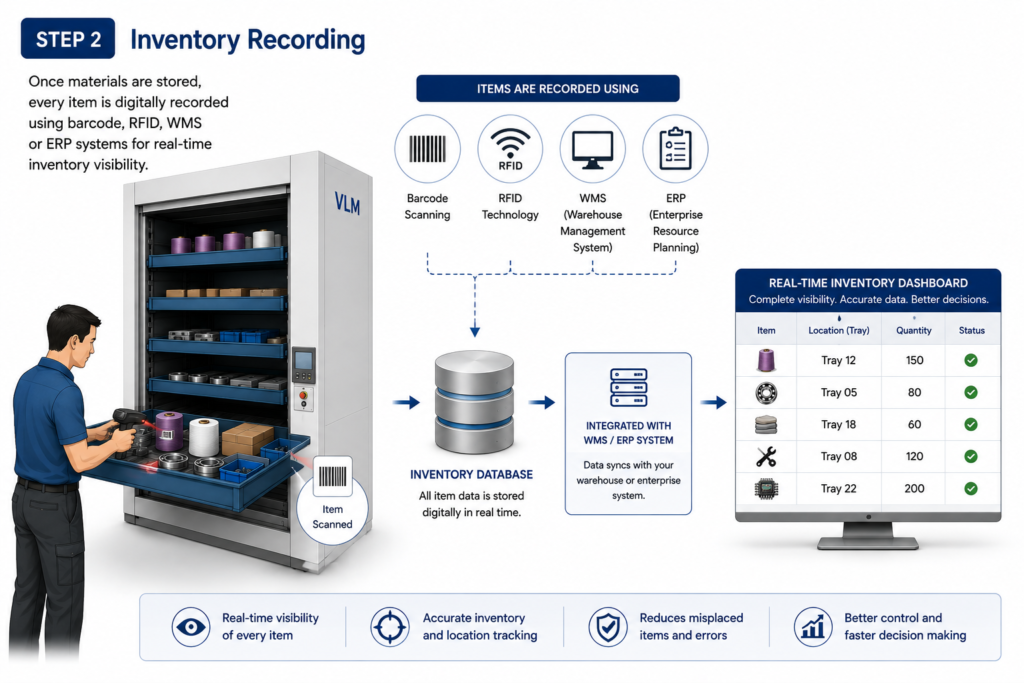
Once materials are stored, every item is digitally recorded.
Depending on your warehouse setup, inventory can be tracked using:
- Barcode scanning
- RFID technology
- Warehouse Management Systems (WMS)
- Enterprise Resource Planning (ERP) software
This gives you real-time visibility into your inventory.
For example, if your R&D department needs a specific fabric sample, your team can quickly identify its exact storage location instead of manually searching through cabinets or storage racks
Digital inventory management also helps reduce misplaced items and improve stock accuracy.
With accurate inventory records and real-time visibility, businesses can optimize inventory levels, reduce excess stock, and ensure critical materials are available when needed.
In practice, many manufacturers discover that inventory issues are often process-related rather than stock-related. Real-time inventory visibility enables production, maintenance, and warehouse teams to work from the same data, helping avoid delays caused by missing or incorrectly recorded materials.
Step 3 – Automatic Retrieval
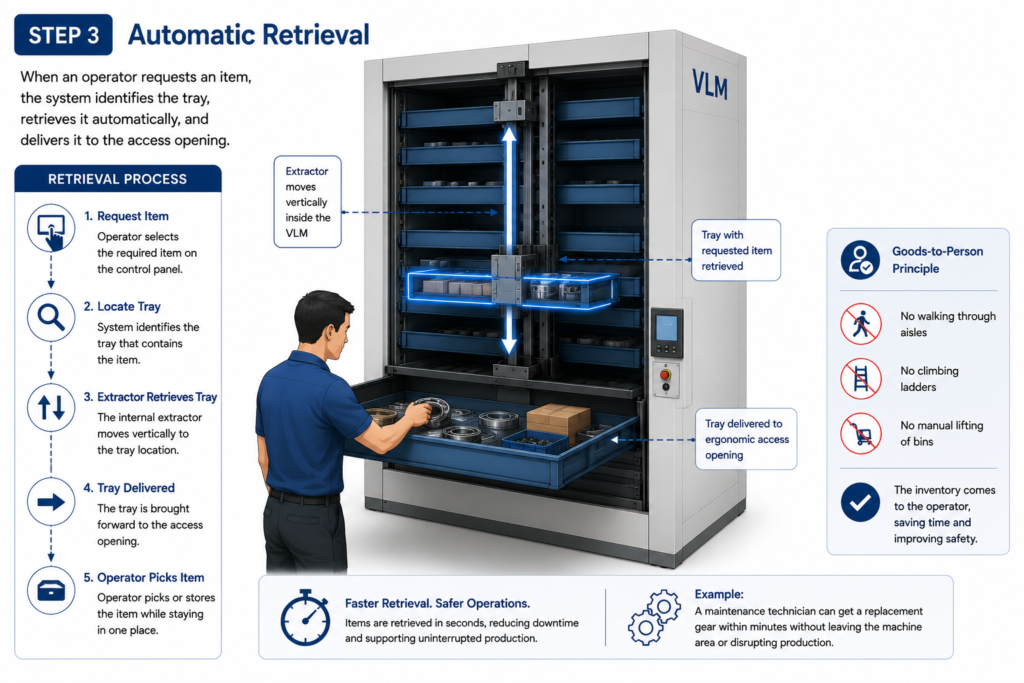
When an operator requests an item, the system immediately identifies which tray contains it.
An internal extractor travels vertically inside the machine, retrieves the required tray, and safely delivers it to the access opening.
The operator remains in one place throughout the process.
Instead of walking through multiple warehouse aisles, climbing ladders, or manually lifting storage bins, the required inventory comes directly to them.
This significantly reduces travel time while improving workplace safety.
In high-volume manufacturing environments, even small reductions in retrieval time can add up over the course of a shift. Faster access to materials helps maintenance teams respond more quickly and allows production to continue with fewer interruptions.
For example, if a maintenance technician urgently needs a replacement gear during machine servicing, they can retrieve it within minutes without disrupting ongoing production.
Step 4 – Return and Storage
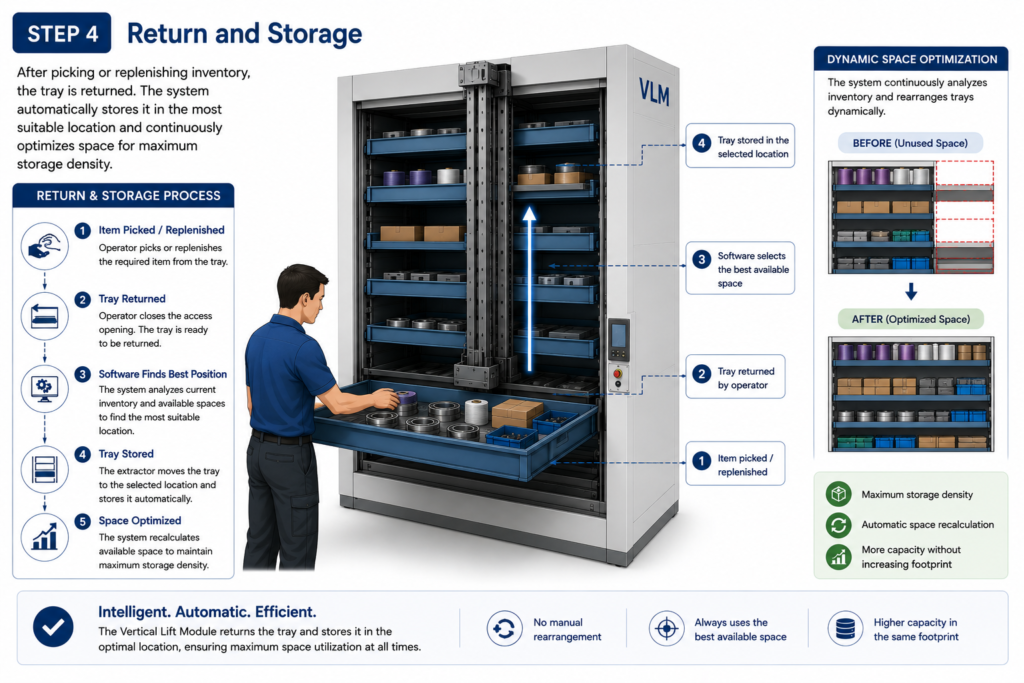
After picking or replenishing inventory, the operator closes the access opening.
The Vertical Lift Module automatically returns the tray to the most suitable storage location.
As inventory changes over time, the software continuously recalculates available storage space to maintain maximum storage density.
This dynamic storage method helps you utilize every available inch inside the machine without requiring manual shelf rearrangement.
See a Vertical Lift Module in Action
Understanding the working process becomes much easier when you see it in action. Watch the video below to see how a Vertical Lift Module stores, retrieves, and delivers inventory using the goods-to-person principle. You’ll also get a better idea of how the system optimizes vertical space and simplifies day-to-day warehouse operations.
Main Components of a Vertical Lift Module
A Vertical Lift Module combines mechanical systems, intelligent software, and safety features to create an efficient storage solution.
Understanding its main components will help you appreciate how the entire system works together.
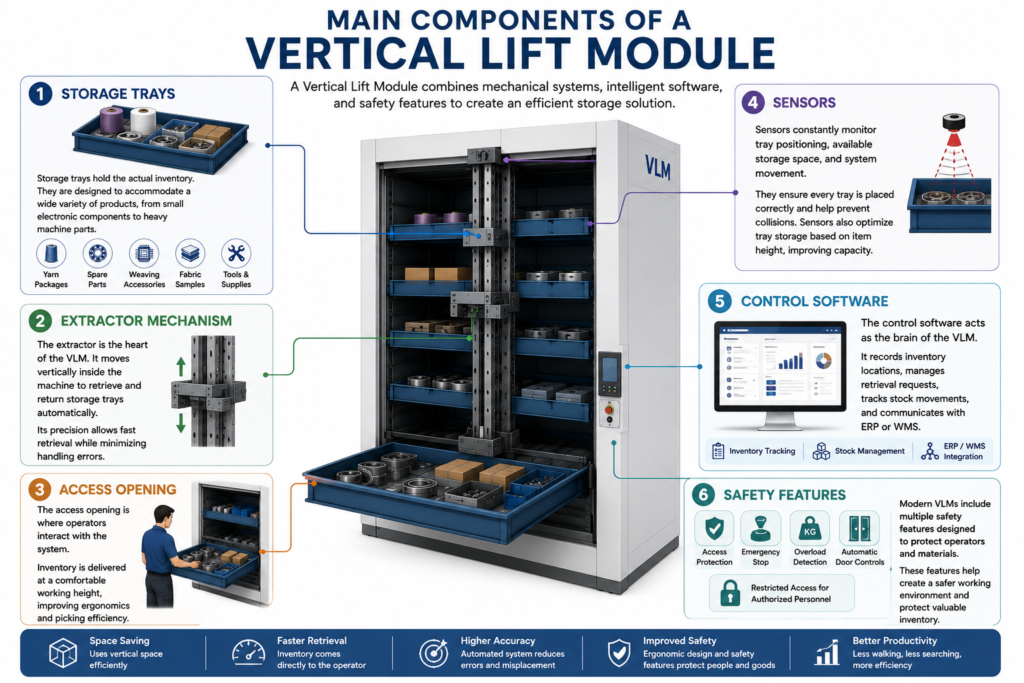
- Storage Trays
Storage trays hold the actual inventory.
These trays are designed to accommodate a wide variety of products, from small electronic components to heavy machine parts.
In textile manufacturing, storage trays are commonly used for yarn packages, spare parts, weaving accessories, fabric samples, tooling, and maintenance supplies.
Different tray sizes allow you to organize inventory based on product dimensions and weight.
- Extractor Mechanism
The extractor is the heart of the Vertical Lift Module.
It moves vertically inside the machine to retrieve and return storage trays automatically.
Its precision allows fast retrieval while minimizing handling errors.
For example, if your production team needs a specific weaving reed during a machine changeover, the extractor quickly locates and delivers the correct tray without requiring manual searching.
- Access Opening
The access opening is where operators interact with the system.
Instead of employees climbing ladders or reaching high shelves, inventory is delivered at a comfortable working height.
This ergonomic design reduces physical strain and improves picking efficiency during daily operations.
- Sensors
Sensors constantly monitor tray positioning, available storage space, and system movement.
They ensure every tray is placed correctly and help prevent collisions inside the machine.
Many systems also use sensors to optimize tray storage based on item height, improving overall storage capacity.
- Control Software
The control software acts as the brain of the Vertical Lift Module.
It records inventory locations, manages retrieval requests, tracks stock movements, and communicates with ERP or warehouse management systems.
This provides complete inventory visibility while reducing manual record-keeping.
- Safety Features
Modern Vertical Lift Modules include multiple safety features designed to protect both operators and stored materials.
These may include access protection systems, emergency stop functions, overload detection, automatic door controls, and restricted access for authorized personnel.
These features help create a safer working environment while protecting valuable inventory from accidental damage.
6 Benefits of a Vertical Lift Module Storage System
A Vertical Lift Module does more than organize inventory. It helps manufacturers maximize available space, improve inventory control, enhance workplace safety, and build more efficient warehouse operations. Here are six key benefits.
Maximizes Vertical Storage Space
A Vertical Lift Module makes full use of your facility’s vertical height, with systems that can be built up to 12 meters and customized in 500 mm height increments to match your available space. The taller the system, the greater the storage capacity within the same floor area. This allows you to accommodate growing inventory without expanding your warehouse footprint, freeing up valuable space for production and other operations.
Improves Inventory Accuracy
Every item stored in a Vertical Lift Module is assigned a predefined location through the system software, making inventory easy to locate and retrieve. Integration with barcode scanning, RFID, or ERP systems further improves picking accuracy, reduces misplaced inventory, and provides better visibility across warehouse operations.
Faster Picking and Retrieval
Since inventory is organized, traceable, and delivered directly to the operator, finding the right item takes much less time. Faster access to spare parts, tools, or production materials helps reduce machine downtime, improve workforce productivity, and keep manufacturing processes running smoothly.
Enhances Workplace Safety
With the goods-to-person principle, operators retrieve materials at a comfortable ergonomic height instead of climbing ladders, bending, or manually lifting heavy items. This reduces physical strain and helps minimize workplace accidents while creating a safer working environment.
Reduces Product Damage
Products are stored in enclosed trays within the Vertical Lift Module, protecting them from dust, environmental exposure, and unnecessary handling. Since materials remain securely stored until required, the risk of product damage or mishandling is significantly reduced, helping maintain the quality of yarn, fabric samples, spare parts, and other valuable inventory.
Supports Lean Manufacturing
A Vertical Lift Module supports lean manufacturing by reducing warehouse floor space requirements, minimizing manual material movement, and lowering dependence on manpower for storage and retrieval activities. Better inventory visibility and faster access to materials help streamline workflows and improve overall operational efficiency.
Vertical Lift Module vs Traditional Shelving
At first glance, both storage methods may seem capable of organizing inventory. However, their impact on productivity, storage capacity, and warehouse operations is very different.
Here’s a comparison.
| Parameter | Vertical Lift Module | Traditional Shelving |
| Space Utilization | Uses vertical height efficiently and requires a smaller floor footprint | Occupies more floor space with multiple aisles |
| Storage Capacity | High-density storage through optimized tray placement | Limited by fixed shelves and available floor area |
| Picking Speed | Automated retrieval delivers items directly to the operator | Employees manually search and retrieve items |
| Inventory Accuracy | Digital inventory tracking with barcode, RFID, and ERP integration | Greater dependence on manual inventory management |
| Labor Requirement | Reduces walking, lifting, and repetitive manual tasks | Requires more manual handling and travel |
| Workplace Safety | Ergonomic access reduces climbing and heavy lifting | Higher risk from ladders, bending, and manual handling |
| Automation and Integration | Easily integrates with ERP and Warehouse Management Systems | Limited automation and software connectivity |
| Best Suited For | Manufacturing facilities, textile industries, warehouses with high inventory volumes | Small warehouses with limited inventory and low picking frequency |
While traditional shelving still works well for smaller operations, businesses handling hundreds or thousands of inventory items often benefit from the speed, organization, and space efficiency offered by a Vertical Lift Module.
Industries That Use Vertical Lift Modules
Although Vertical Lift Modules are becoming increasingly common in warehouses, they are also widely used across many manufacturing industries where inventory accuracy and efficient storage are critical.
Here’s how different industries benefit.
Textile Manufacturing
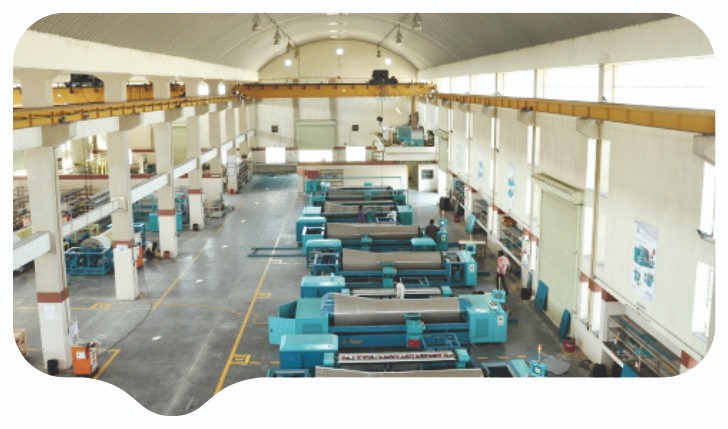
Textile manufacturers deal with a wide variety of inventory every day.
This includes yarn packages, machine spare parts, dyes, weaving accessories, quality samples, maintenance tools, and production consumables.
Instead of storing these materials across different storage areas, a Vertical Lift Module keeps everything organized in one centralized system.
For example, when a loom requires a replacement component during production, the maintenance team can retrieve it immediately instead of spending valuable time searching through storage racks.
Quick access to critical spare parts helps maintenance teams reduce machine downtime, minimizing production interruptions and improving equipment availability.
Technical Textile Industry
Technical textiles often involve specialized materials used in industries such as healthcare, automotive, aerospace, and construction.
These materials usually require better organization and careful handling.
A Vertical Lift Module helps store specialty fabrics, testing samples, coated materials, and development components while maintaining easy access for production and research teams.
Garment Manufacturing
Garment manufacturers handle thousands of trims, labels, buttons, zippers, sewing accessories, and replacement machine parts.
Keeping these items organized helps reduce delays during production planning.
Instead of maintaining multiple storage cabinets, manufacturers can centralize these materials inside a Vertical Lift Module for faster retrieval.
Automotive Manufacturing
Automotive facilities store numerous tools, dies, fixtures, replacement parts, and maintenance inventory.
Using a Vertical Lift Module makes these components easier to locate while reducing unnecessary movement across large production facilities.
Aerospace
Aerospace manufacturers often manage expensive precision components where traceability is essential.
A Vertical Lift Module helps maintain organized storage while supporting accurate inventory tracking for critical parts.

Pharmaceuticals
Pharmaceutical companies frequently use automated storage systems to organize laboratory supplies, production tools, packaging materials, and regulated inventory.
Automated storage also improves inventory control and reduces manual handling.

Electronics Manufacturing
Electronic components are often small, delicate, and available in thousands of different variants.
A Vertical Lift Module allows manufacturers to organize circuit boards, connectors, sensors, and electronic assemblies without occupying excessive warehouse space.
Industrial Warehousing and Distribution
Warehouses serving multiple industries often manage a large number of SKUs with varying sizes and picking frequencies.
A Vertical Lift Module simplifies storage by reducing travel time, improving picking efficiency, and making better use of available warehouse space.
Whether you store spare parts, maintenance inventory, finished goods, or production supplies, automated retrieval helps your warehouse operate more efficiently.
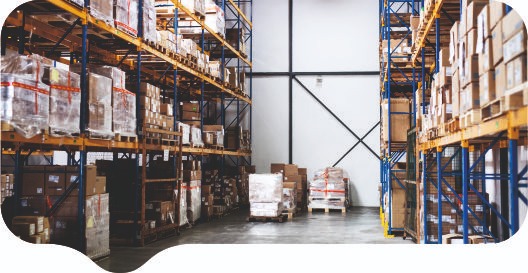
Applications of Vertical Lift Modules in Textile Manufacturing
Textile manufacturers store a wide range of materials, from yarn packages and sampling solutions to spare parts and production tools. A Vertical Lift Module helps organize these items, making them easier to store, locate, and retrieve.
| Application | How a Vertical Lift Module Helps |
| Yarn Packages | Organizes yarn by count, material, or batch for faster retrieval and improved inventory control. |
| Fabric Samples | Keeps samples organized for quick access during product development, quality checks, and repeat orders. |
| Spare Parts | Stores machine components in one place, helping maintenance teams reduce equipment downtime. |
| Loom Accessories | Centralizes reeds, heald frames, shuttles, and other accessories for easier access and better organization. |
| Dyes and Chemicals | Improves visibility and organization of dyes, pigments, and production chemicals. |
| Production Tools | Stores measuring instruments, cutting tools, and maintenance kits in a secure, easily accessible location. |
| Maintenance Inventory | Organizes consumables like fasteners, lubricants, sensors, and electrical components for faster maintenance. |
| Technical Textile Components | Protects specialized fabrics, composites, filters, and development samples while simplifying retrieval. |
How to Choose the Right Vertical Lift Module
Before selecting a system, it is important to evaluate not only your current storage requirements but also future production plans, inventory growth, and operational workflows. Choosing a solution based solely on today’s needs may limit long-term flexibility.
Check Your Available Ceiling Height
Choose a system that makes the best use of your building’s vertical space to maximize storage capacity.
Confirm the Load Capacity You Need
Make sure the tray capacity can safely handle the weight of your products, whether you store yarn packages, spare parts, or heavy machine components.
Match Tray Dimensions to Your Inventory
Select tray sizes that suit the dimensions of your inventory to improve storage efficiency and retrieval.
Think About the Type of Product You Store
Consider the type of items you store, such as fabric samples, tools, accessories, or technical textile materials, to ensure the system meets your storage requirements.
Factor In Your Picking Frequency
If certain items are accessed frequently, choose a system designed for fast and efficient retrieval.
Look For Software Integration
Look for a vertical lift module that integrates with your ERP or warehouse management system for better inventory visibility.
Prioritize Safety Features
Prioritize systems with essential safety features such as overload protection, emergency stops, and access controls.
Plan For Future Scalability
Choose a solution that can support your future storage needs as your inventory and operations grow.
Optimize Your Storage with a Smarter Solution
Make better use of your warehouse space with Rabatex’s Vertical Lift Module. Improve storage capacity, inventory control, and operational efficiency without expanding your facility.
Making the Most of Your Warehouse with a Vertical Lift Module
As textile manufacturing continues to evolve, efficient storage is becoming just as important as efficient production. A Vertical Lift Module helps you maximize available space, improve inventory organization, speed up material retrieval, and create a safer workplace.
Beyond improving storage, a Vertical Lift Module helps streamline warehouse operations by reducing manual handling, improving inventory flow, and supporting greater operational efficiency.
Whether you manage yarn packages, fabric samples, spare parts, production tools, or technical textile components, adopting a Vertical Lift Module can help streamline your day-to-day operations and support long-term growth.
At Rabatex, we understand the storage challenges faced by textile manufacturers. Our Vertical Lift Module is designed to help businesses optimize warehouse space, improve inventory accessibility, and support smarter material handling with reliable automation. Whether you’re modernizing an existing facility or planning a new one, Rabatex provides solutions built to meet the evolving needs of the textile industry.
Have questions about implementing a Vertical Lift Module?
Get in touch with the Rabatex team for expert guidance and tailored storage solutions.
Frequently Asked Questions
What is a vertical lift module used for?
A Vertical Lift Module is used to store and retrieve inventory automatically. It helps businesses maximize storage space, improve inventory accuracy, and reduce the time required to locate materials.
How much floor space can a vertical lift module save?
The exact savings depend on the system size and warehouse layout. Many businesses can recover a significant amount of floor space by utilizing vertical storage instead of expanding horizontal shelving.
What is the difference between a vertical lift module and an AS/RS?
A Vertical Lift Module is one type of Automated Storage and Retrieval System (AS/RS). While AS/RS includes various automated storage technologies, a Vertical Lift Module specifically stores inventory in vertically arranged trays and delivers them directly to the operator.
What industries commonly use vertical lift modules?
Vertical Lift Modules are widely used in textile manufacturing, technical textiles, automotive, aerospace, pharmaceuticals, electronics manufacturing, industrial warehouses, and logistics operations.
How much weight can a vertical lift module tray hold?
The load capacity varies by manufacturer and model. Depending on the system, trays may be designed to store anything from lightweight samples to heavy industrial components weighing several hundred kilograms.
Is a vertical lift module suitable for storing fabric rolls and yarn cones?
Yes. Vertical Lift Modules can be configured to store yarn packages, fabric samples, accessories, and many types of textile materials. Storage suitability depends on the dimensions and weight of the products.
What is the average lifespan of a vertical lift module?
With proper maintenance and regular servicing, a Vertical Lift Module can operate reliably for many years. The actual lifespan depends on usage, operating conditions, and maintenance practices.
Do vertical lift modules require special building or ceiling requirements?
Most systems require sufficient ceiling height to maximize storage capacity, along with adequate floor strength and electrical connections. It is recommended to evaluate your facility before installation to ensure the system fits your operational requirements.